The poor pay homage to St. Wenceslaus
The Author Tobias Franz Stallmeyer
Date of creation years 1710-1720
Dimensions height 970 cm, width 760 cm
Material / Technique carpentry and woodcarving techniques gilding and polychrome polished primer wood
Exposure location Main Nave southern wall over the first inter-nave arcade going from the east


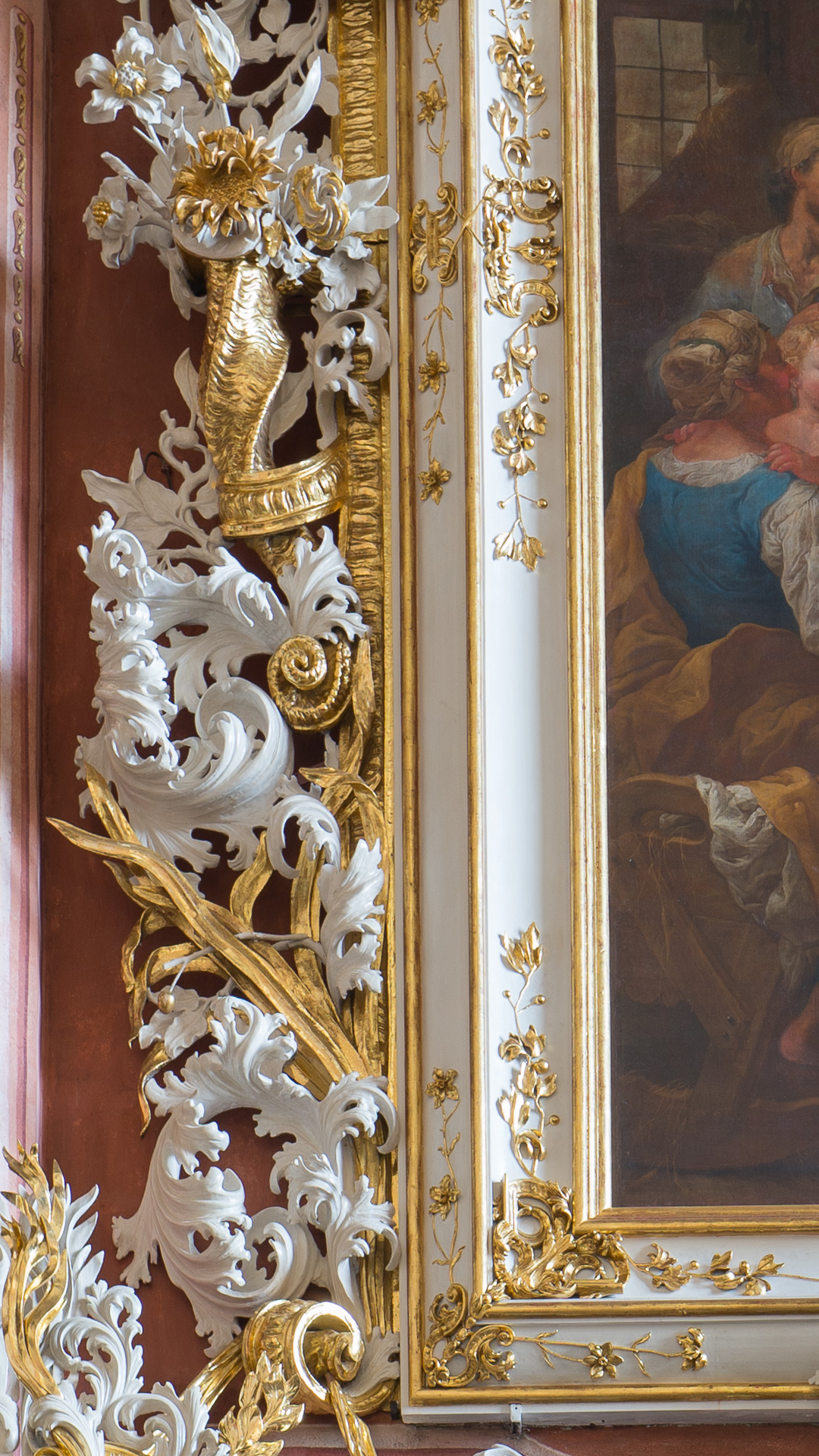

Description: The frame of the picture, in the shape of a vertical rectangle, in its main part is made of relatively wide slats, profiled in such a way that they create the illusion of a greater than the actual depth of the frame. On the outside and inside the main part of the frame and in the middle, between the wider slats in the white color of the polished primer, there are three narrow, profiled gold slats (the slat closest to the image field is slightly wider). The white slats they capture are the inner one wider than the outer one and concave, while the other one, narrower, is set straight towards the viewer. On both of these slats, there are ornamental motifs placed within the width of the slats, flat, golden, and made of wavy thin twigs with leaves and a few flowers; floral patterns are complemented by scrolls of little varied ornaments made of tape sections. The described motifs occur near the corners and in the middle of the side and top sections of the frame. At the vertical sides and the upper edge of the frame, plastic, openwork “ears” are placed outside it – scrolls of acanthus leaves in a white color of polished primer with a slightly dry styling, intertwined with sections of a rather narrow, golden, cross-grooved ribbon with ends wrapped in a volute, overlapping on the side slats of the frame in 2/3 of the height. The decoration of the “ears” on the sides of the frame in two places is complemented by bouquets placed in cornucopias and bunches of smooth, golden stems. The scroll of the ornament at the upper edge is symmetrically shaped, slightly raised on the axis. Lateral “ears” with the outer edge very irregular, slightly bent outwards. At the bottom edge of the frame, on the sides, there are two partially openwork, white and gold garlands, the outer ends of which are attached to the spirally twisted lower ends of the ribbon decorating the “ears” on the sides of the frame. Almost symmetrical garlands, made of varied leaves and twigs with small flowers and ball-shaped fruits. The inner ends of the garlands are attached to a symmetrical cartouche placed in the middle of the lower section of the frame. The top of the cartouche extends onto the field of the picture, and the bottom reaches below the line of the garlands, sticking out strongly from the surface of the frame. Its decorations are mostly plastic and openwork, and the outer edge of the cartouche is irregular, and shaped take the courses of ornamental and heraldic motifs. The general shape of the cartouche is similar to an oval, although its main part, surrounded by an “inner” frame, is six-leaf. In the center, there is a heraldic shield in the shape of a rectangle closed from the top with an arch (hidden under the lower parts of three helmets constituting elements of the jewel, overlapping the edge of the shield). On its sides, you can see indentations on the line of shallow segmental arches. From the bottom, the shield is closed with two different arcs corresponding to the halves of the shield, touching on its axis: from the right side (heraldically) you can see a wavy, concave-convex arch, on the other side a segment of a convex segmental arch. On the shield, there is a coat of arms, and above it a three-piece jewel. On the right (heraldically) side of the coat of arms there are green libraries and on the left red ones. At the same time, they are the main decorative motif of the entire cartouche, in the center of which the shield was placed. The six-leaf “internal” frame (see above) of the main cartouche (set on the axis of the lower section of the frame) is gold, made of sections of a horizontally grooved ribbon ending with spiral twists (four upper sections of the frame) and two scarves at the bottom. Their inner ends are embedded in other decorative motifs of the cartouche, and the outer ones, finished with balls – located behind the place where the scarves are threaded through the twisted openwork acanthus leaves – are connected to the previously described garlands suspended to the lower edge of the frame. The other decorative elements of the cartouche with the coat of arms are white acanthus leaves intertwined with other motifs. On the axis, below, there is also another cartouche in a rich frame, intended for an inscription. Cartouche in the form of a horizontally stretched rectangle with semicircular endings on the horizontal axis, with a blue field, surrounded by a frame mainly in gold, incl. made of incised ribbon, tied on a vertical axis with doubled volutes made of sections of incised ribbon of a different type, as well as of white acanthus leaves. The coat of arms of the von Nimptsch family is visible in the shield in the center of the main cartouche overlapping the lower section of the frame. The coat of arms is divided into four fields. In the upper right (heraldic) silver field and the lower left (heraldic) silver field, there is a repeated emblem in the form of two gold open crowns of an indeterminate rank (usually defined by the number of “sticks”), with their open parts turned towards each other (fleurons of leaves acanthus). In the upper left field (heraldically) on a grey-green background there is an emblem in the form of a golden dragon sitting on a red base facing right (heraldically) and breathing fire. The lower right field (heraldic) has been divided horizontally into two parts, of which the lower one, reaching 1/3 of the height of the entire field, is brown and the upper one of a similar color as seen in the previously described field. A silver-gray palm tree is depicted in the upper field. The main shield of the coat of arms also has a heart field in the center in the shape of a slightly vertically elongated rectangular shield, semicircular at the bottom, crowned with a golden open crown made of fleurons from acanthus leaves (slightly similar to the pairs of crowns in the emblems visible nearby). The heart field is divided horizontally into two parts. In the lower one, you can also see the vertical division of the background: in the right (heraldic) part the background color is red, and in the other part it is grey-green. The upper part of the heart field is grey-silver. In the heart field, the emblem is placed jointly on all three parts – there is a gray-black vertically positioned unicorn pointing to the right (heraldic) side with a silver fishtail. A three-piece jewel above the dial. Each section at the bottom features a silver-gray helmet with gold details, surmounted by a golden open crown of acanthus leaf fleurons; the helmets were framed with gray-black labradors. Above the helmet on the right (heraldically) side there is a golden-winged fire-breathing dragon directed to the left (heraldically) side, over the middle helmet there is a silver-gray palm tree, above the third helmet you can see the upper half of a gray-black unicorn with a silver horn directed to the right (heraldically) side. In a horizontal field at the bottom of the mentioned cartouche there are gold letters “C. F.G.N.”
History: An extremely richly decorated frame encloses a large painting belonging to the cycle placed on the walls of the nave dedicated to the two saint patrons of the church (and also the patrons of the countries they came from): Stanislaus, the bishop of Cracow and a martyr, and Wenceslaus, the Czech prince and also a martyr. A painting illustrating a scene from the life of St. Wenceslaus. The entire series was created on the initiative of the Jesuits, but only one painting and its frame were financed by the college in Świdnica. The painting in question was funded by a well-known Silesian magnate, who is identified by the coat of arms and letters on the shield below. In this case, it was about the person hidden under the abbreviation “C. F.G.N.” – it was “Christoph Ferdinand Graf von Nimptsch” or “Christoph Ferdinand Count von Nimptsch”. We do not know the exact date of its foundation (the cycle began around 1710). However, probably, this work was not done until around 1720, when the painter was paid for the execution of the last two (out of a total of three) paintings showing scenes from the life of St. Wenceslaus.
Characteristics: The decision to make large paintings illustrating the lives of its patrons for the church in Świdnica was obvious due to the lively liturgical cult of the saints mentioned in this church. As has already been mentioned, the Jesuits – probably funded only one painting. Three of the remaining ones were funded by representatives of the most powerful Silesian aristocracy. If you look closely at the founders belonging to it, you can say that they had some common features. This can be perfectly traced by comparing the – trivial – biography of Christoph Ferdinand Count von Nimptsch with others (whose exact dates of life – even though he was a very famous person – are difficult to determine). Like everyone else in this group, he came from an old, wealthy Silesian family of the Catholic faith, although some of these aristocrats’ ancestors were Protestants, and they abandoned their faith under duress or because of the desire to have good relations with the Viennese, arch-Catholic Habsburg court. Nimptsch, like other founders of paintings, did not reach his fortune and position alone. To a large extent, he owed it to his thrifty ancestors: Christoph Ferdinand, especially to his father, Hans Heinrich, the most powerful man in this area at the turn of the 17th and 18th centuries, holding the key function of starost in two Silesian duchies, endowed with the hereditary title of count by the emperor. His son, the founder of the painting, followed a similar career, holding several important offices by the grace of the emperor. Like everyone in his sphere, he took care of a marriage that enriched his affinities and expanded his influence: in 1716 he married Baroness Maria Magdalena von Gilleis. The count’s fortune – which was typical – had its source in huge landed estates, and the measure of his wealth was the possession of several sumptuous residences, among which his ancestral seat in Olszany stood out. The only interesting feature of Nimptsch’s personality was his great loyalty to the Habsburgs. When in 1741 this area was seized by Prussia for a long time, unlike the majority of Silesian aristocrats who were willing to swear an oath of loyalty to the new government for keeping their estates, Christoph Ferdinand remained faithful to the empire and fled to Austria losing all his estates in Silesia. It is difficult to say how deep the religiousness of the count and his wife was in the most splendid period of their lives. They are quite known numerous and generous pious foundations for the benefit of the Catholic Church in Silesia, and not all of them had an ostentatious and propaganda character. Certainly, the count had some deeper relations with the Świdnica Jesuits, since he decided to support them and finance one of the great paintings today located in the nave of the cathedral.
Bibliografia
Hermann Hoffmann, Die katholische Pfarrkirche in Schweidnitz, Schweidnitz 1930, s. 12-13.
Danuta Hanulanka, Świdnica, Wydanie II poprawione i uzupełnione, [seria: „Śląsk w Zabytkach Sztuki”, pod redakcją T. Broniewskiego i M. Zlata], Wrocław-Warszawa-Kraków-Gdańsk 1973, s. 93
Edmund Nawrocki, Kościół parafialny św. Stanisława i św. Wacława w Świdnicy. Przewodnik, Świdnica 1990, s. 23
Rainer Sachs, Teresa Sokół, Życie i twórczość rzeźbiarza Tobiasa Franza Stallmeyera (1673-1747), [w:] Dziedzictwo artystyczne Świdnicy, Pod redakcją Bogusława Czechowicza, [Książka zawiera materiały z sesji naukowej odbytej w Świdnicy w dniu 2 czerwca 2000 roku], Wrocław- Świdnica 2003, s. 152
Dariusz Galewski, Kościół Jezuitów w Świdnicy na tle pozostałych gotyckich świątyń prowincji czeskiej Towarzystwa Jezusowego [w:] Śląsk i Czechy. Wspólne drogi sztuki, Materiały konferencji naukowej dedykowane Profesorowi Janowi Wrabecowi, [seria: „Acta Universitatis Wratislaviensis” No 2953, „Historia Sztuki” XXIV], Wrocław 2007, s. 257 i przypis 29.
Sobiesław Nowotny, Przewodnik po świdnickiej katedrze, Autor zdjęć Mariusz Barcicki, Świdnica 2009, s. 67 i 70.
Dariusz Galewski, Jezuici wobec tradycji średniowiecznej. Barokizacje kościołów w Kłodzku, Świdnicy, Jeleniej Górze i Żaganiu, [seria: „Ars Vetus et Nova”, Redaktor serii W. Bałus, T. XXXVI], Kraków 2012, s. 194 i 222 oraz tamże przypisy 29 i 30.
Jeremias Joseph Knechtel (1679-1750). Legnicki malarz doby baroku, Pod redakcją Andrzeja Kozieła i Emilii Kłody, [katalog wystawy], Muzeum Miedzi w Legnicy, Akademia Rycerska, październik 2012 – kwiecień 2013, Legnica 2012, poz. kat. A.96-A.101 na s. 192-198, kompletne zestawienie literatury do obrazów z obu cykli – s. 194 (część poz. dotyczy także ram) – teksty opr. Emilia Kłoda: na s. 195 ważna wzmianka o obrazie (jego temat określony jako Św. Wacław przed skruszonym wrogiem padającym mu do nóg), do którego przynależy omawiana rama, uznająca ten obraz za dzieło innego artysty; brak wzmianki o samej ramie i il.
Barbara Skoczylas-Stadnik [tekst], Franciszek Grzywacz [fotografie], Katedra świdnicka perłą Dolnego Śląska, Legnica 2016, s. 36 i 39 oraz s. 36-39 (il. z podpisami), obraz Ubodzy oddają hołd św. Wacławowi – il. prawa na s. 39.
Sobiesław Nowotny, Herby na ramach wielkich obrazów w nawie głównej świdnickiej katedry, Świdnica 2021, opracowanie historyczne w Archiwum Firmy Konserwatorskiej Piotr Białko w Krakowie [wydruk].