St. Wenceslaus orders the building of churches and the destruction of pagan statues in Bohemia
The Author Jeremias Joseph Knechtel
Date of creation around 1720
Dimensions height 589 cm, width 430 cm
Material / Technique canvas colored primer oil technique
Exposure location Main Nave southern wall over the third inter-nave arcade going from the east
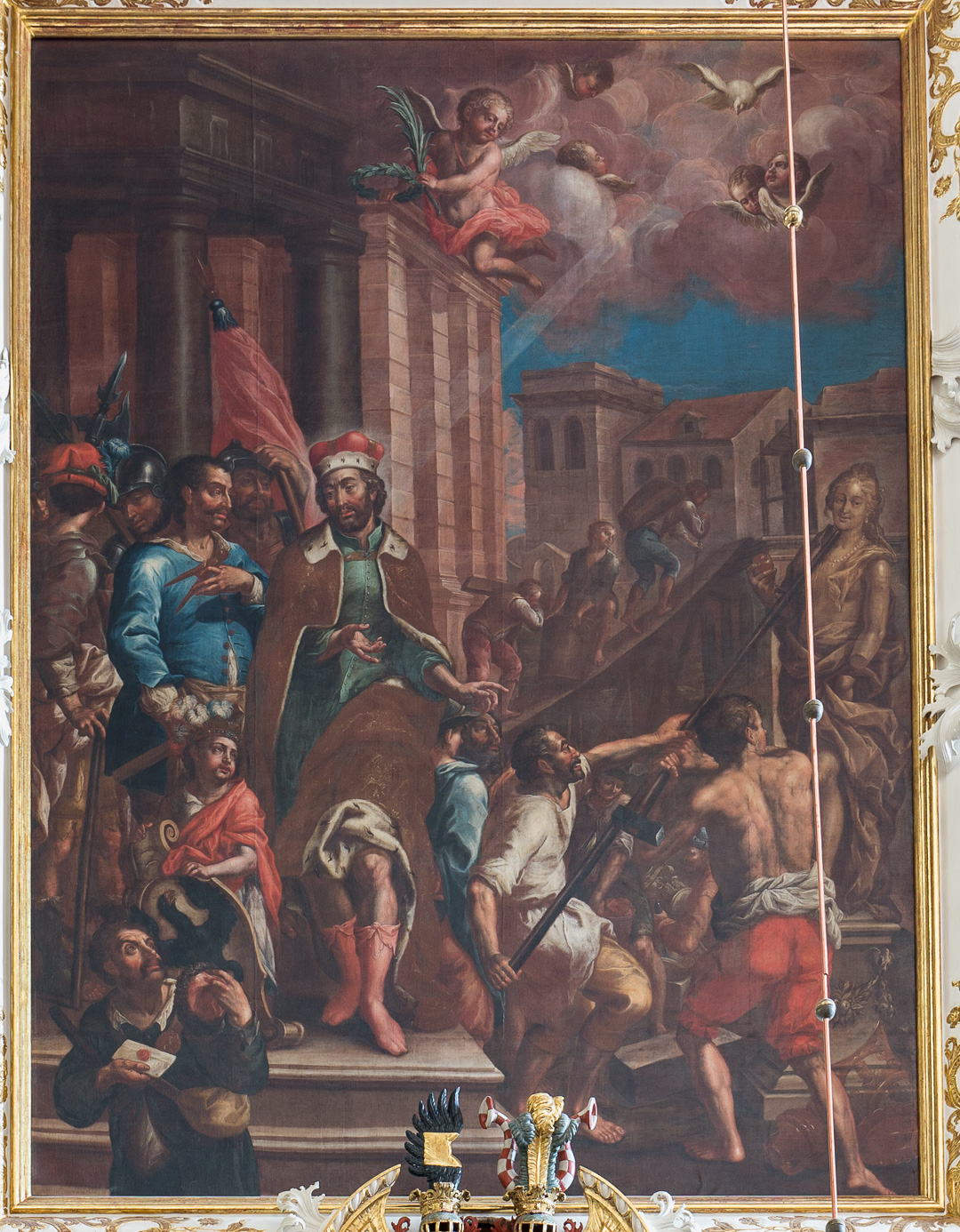


Description: A picture painted on a canvas in the form of a vertically positioned rectangle. The composition depicts St. Wenceslaus, a Czech prince ordering the destruction of pagan temples and the construction of churches. A multi-figure scene with a crowd of figures shown in various poses and costumes, with a complex composition. The whole thing takes place in front of the facade of the prince’s palace, probably in the city center, in a place (on the square?) surrounded by buildings; architectural motifs and other realities are presented in a completely ahistorical and fantastic way, although in line with the stylistic features of late baroque architecture. The composition has several plans and several separate scenes (groups of figures): the left (from the viewer) half of the painting is occupied by the view of the palace and a group of figures in front of it, led by St. Wenceslaus. In turn, the right half of the painting covers several zones – at the bottom, you can see the scene of overthrowing the statue of the deity, higher in the background the construction of the temple is shown, behind it and above there are light brown buildings of the city, above which you can see a strip of blue sky, and finally, at the very top, you can see gray-pink clouds, against which the winged heads of cherubs are placed, and – to the right (heraldically) of them, almost on the axis of the picture – the figure of an angel covered with a brick-red drapery and holding a green laurel wreath and a palm branch. The most important for understanding the content program of the image are the three listed at the beginning of the scene. The front of the monumental buildings of the palace is visible in the perspective on the left (from the viewer) side of the painting, in front of the grey-green portico with columns (behind which the façade of the palace with pillar divisions, flesh-pink color is visible in the background), on a three-step pedestal there is a group of standing figures shown in animated poses. The central figure here is St. Wenceslaus giving instructions to the builder pictured next to him. He stands close to the edge of the platform, among the figures of the specified group, he is the closest to the axis of the painting. The saint is facing the viewer, in a clear contrapposto, with his left leg stretched far forward. His head tilted slightly to the side, is directed almost 3/4 to the heraldic right; the face of a mature man with a weathered complexion is framed by stubble with a short beard and hair on the sides – stubble and brown hair. Wenceslaus’s arms are bent at the elbows and extended to the side in the opposite direction then the head is turned. The hands shown at the height of the hips make gestures indicating the scenes taking place on the right side of the picture (from the viewer). The saint is dressed in a rich ducal outfit: a green robe fastened at the front with a series of small buttons and a richly pleated brown coat lined with ermine. The coat creates a very dynamic fold above the left knee. The prince’s legs are exposed to the knees, and a kind of leg cover is visible in the form of tight-fitting pink “boots”. On the head of the sacred ducal miter, red, with a white, ermine hem at the bottom. The conversation partner for the prince is the builder standing next to him on the right (heraldic) side. A man with a very expressive physiognomy, a prominent aquiline nose, long hair, and a bushy mustache, dressed in a white shirt and a blue caftan, turns to the prince and holds a compass in his left hand at chest height as a sign of his profession. The pair are flanked by courtiers and halberd-wielding soldiers, one holding a red flagstaff. Before the prince and the architect, a little boy is depicted dressed in a white robe and covered with red drapery, with a jeweled cap with feathers on his head. The boy holds a large shield in front of him, richly framed with volutes on a vertical axis, containing the emblem of the Přemyslid dynasty: a black eagle (precisely an eagle) with its beak directed to the left (heraldic) side. Exactly below this escutcheon, below the podium, there is a man depicted from the waist up, with a physiognomy similar to that of a builder, judging by his attributes (travel bag, stick) – a messenger. The scenes depicting the execution of the orders of the Czech patron occupy the right (from the viewer) half of the picture. At the bottom of the stairs leading to the palace, there is a group of five men in colorful robes (one, shown in the foreground, on the right side – from the viewer – is naked from the waist up), mostly shown in animated poses, in dynamic movement. Two men in the foreground destroy and topple a statue standing on a high plinth decorated with a garland, visible just off the right edge of the painting. Below the pedestal, overturned bronze vessels are shown. The statue, entirely in grey-white (imitating stone), shows a woman standing in full form, facing the axis of the image, dressed in richly pleated robes, holding an apple in her right hand (the only color accent within the sculpture); the statue’s left hand is broken. The men described hitting or are about to hit the piece with poles and a hammer. To the right (heraldically) of them, the only man standing calmly in the group watches the scene. On the further partially visible, two more men smashing stone architectural details, among which you can see the head of the column. Above, in a much further background, the last of the main scenes of the painting: a diagonal, steep footbridge, running from the right (heraldically) upwards to the left (heraldically), towards the top of the erected building visible near the right edge of the painting. Three men come up the footbridge carrying and pulling baskets and beams.
Provenance: The painting belongs to the series placed on the walls of the nave dedicated to the two saint patrons of the church: Stanislaus, the bishop of Cracow and a martyr, and Wenceslaus, the Czech prince and also a martyr. The entire series was created on the initiative of the Jesuits, but only one painting was financed by the college in Świdnica. The rest were funded by people and institutions (mainly the church) only sympathizing with the Świdnica college. Only in a few cases can one be tempted to determine the time of such a foundation. About the work discussed here, from the hypothetical identification of the donor – it was probably Maria Elisabeth Countess von Nostitz, appearing here without her husband, who died in 1712 – one can specify, for example, the lower limit of the time of the painting’s creation (after 1712). However, this work was likely done even later, around 1720, when the painter was paid for the execution of the last two (out of a total of three) paintings showing scenes from the life of St. Wenceslaus. The founder died in 1738, so also in the case of the second dating, her participation in financing the work is beyond doubt.
Characteristics: The decision to make large paintings illustrating the lives of its patrons for the church in Świdnica was obvious due to the lively liturgical cult of the saints mentioned in this church. Out of the six paintings that belong to this part of the cycle, which is located in the nave of the cathedral, three were made with the funds of representatives of the most powerful Silesian aristocracy. Attempts to identify all generous donors have not always been accurate. For example, the painting discussed here, taking into account the fact that the coat of arms on the frame belongs to the well-known Silesian von Nostitz family, was considered a gift from one of the unidentified members of this family. Only recently, the research of Sobiesław Nowotny, an eminent expert on the past of Świdnica, allowed us to determine that the abbreviated inscription below the coat of arms refers to Maria Elizabetha Countess von Nostitz, the widow of one of the most prominent Silesian aristocrats of that period. It was Christoph Wenzel, Count von Nostitz (1645-1712), the owner of numerous landed estates in the Duchy of Świdnica and Jawor. He was strongly associated with the Habsburgs and from 1692 he was the count of the Reich. In 1697-1703, he was the starost of the Duchy of Świdnica-Jawor. The gift of his wife, although marked with letters proving that it was made after the count’s death, can also be treated as the fulfillment of the ambitions of the Silesian magnate in the field of foundations for the Catholic Church in Silesia. Finally, it should be noted that the subject of the work was wrongly defined for a long time – it was defined as the image of St. Wenceslaus reconciling the two combatants, although even a cursory look at the details of the composition leaves no doubt as to the depicted scene. Perhaps the fault was the fact that the painting was hung in the nave at a considerable height.
Bibliografia
Hermann Hoffmann, Die katholische Pfarrkirche in Schweidnitz, Schweidnitz 1930, s. 12-13.
Danuta Hanulanka, Świdnica, Wydanie II poprawione i uzupełnione, [seria: „Śląsk w Zabytkach Sztuki”, pod redakcją T. Broniewskiego i M. Zlata], Wrocław-Warszawa-Kraków-Gdańsk 1973, s. 93
Edmund Nawrocki, Kościół parafialny św. Stanisława i św. Wacława w Świdnicy. Przewodnik, Świdnica 1990, s. 23
Dariusz Galewski, Kościół Jezuitów w Świdnicy na tle pozostałych gotyckich świątyń prowincji czeskiej Towarzystwa Jezusowego [w:] Śląsk i Czechy. Wspólne drogi sztuki, Materiały konferencji naukowej dedykowane Profesorowi Janowi Wrabecowi, [seria: „Acta Universitatis Wratislaviensis” No 2953, „Historia Sztuki” XXIV], Wrocław 2007, s. 257 i przypis 29
Sobiesław Nowotny, Przewodnik po świdnickiej katedrze, Autor zdjęć Mariusz Barcicki, Świdnica 2009, s. 67 i 70
Dariusz Galewski, Jezuici wobec tradycji średniowiecznej. Barokizacje kościołów w Kłodzku, Świdnicy, Jeleniej Górze i Żaganiu, [seria: „Ars Vetus et Nova”, Redaktor serii W. Bałus, T. XXXVI], Kraków 2012, s. 194 i 222 oraz tamże przypisy 29 i 30 (określenie ikonografii dzieła jak we wcześniejszej pracy autora).
Jeremias Joseph Knechtel (1679-1750). Legnicki malarz doby baroku, Pod redakcją Andrzeja Kozieła i Emilii Kłody, [katalog wystawy], Muzeum Miedzi w Legnicy, Akademia Rycerska, październik 2012 – kwiecień 2013, Legnica 2012, poz. kat. A.101 na s. 194, il. na s. 197 (il. górna); tekst ogólny omawiający oba cykle – s. 194-198, kompletne zestawienie literatury do obrazów z obu cykli – s. 194 – teksty opr. Emilia Kłoda.
Barbara Skoczylas-Stadnik [tekst], Franciszek Grzywacz [fotografie], Katedra świdnicka perłą Dolnego Śląska, Legnica 2016, s. 39, il. lewa na s. 39.
Malarstwo barokowe na Śląsku, pod redakcją Andrzeja Kozieła, Wrocław 2017, s. 489 (autorka noty poświęconej malarzowi Jeremiasowi Josephowi Knechtlowi: Emilia Kłoda).
Sobiesław Nowotny, Herby na ramach wielkich obrazów w nawie głównej świdnickiej katedry, Świdnica 2021, opracowanie historyczne w Archiwum Firmy Konserwatorskiej Piotr Białko w Krakowie [wydruk].