St. Wenceslaus orders the building of churches and the destruction of pagan statues in Bohemia
The Author Tobias Franz Stallmeyer
Date of creation years 1710-1720
Dimensions height 977 cm, width 792 cm
Material / Technique carpentry and woodcarving techniques gilding and polychrome polished primer wood
Exposure location Main Nave southern wall over the third inter-nave arcade going from the east

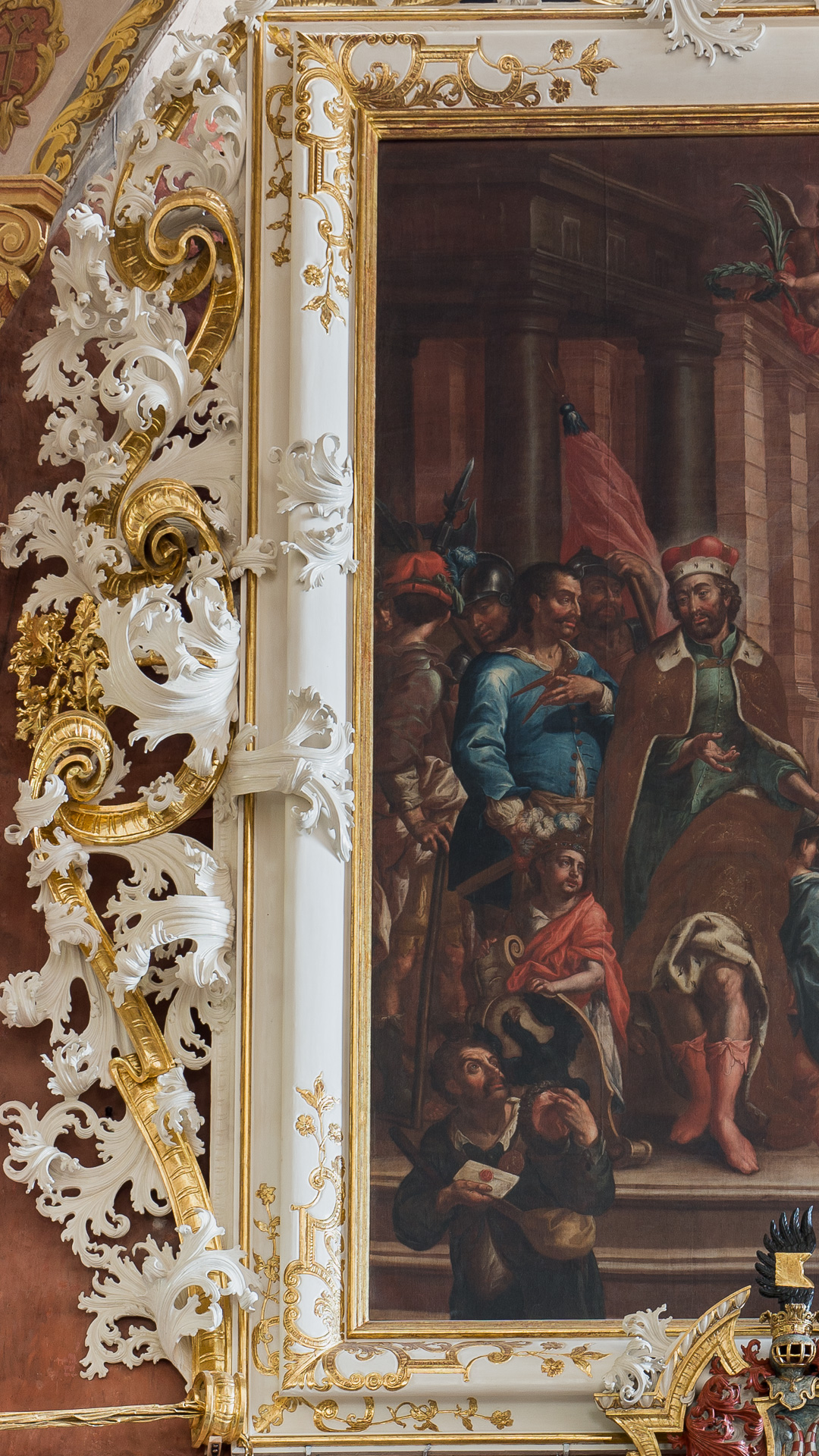


Description: The frame of the picture, in the shape of a vertical rectangle, in its main part is made of relatively wide slats in the white color of the polished primer, profiled in such a way that they create the illusion of a greater than the actual depth of the frame. Outside and inside the main part of the frame, there are narrow, profiled golden strips embracing two internal, wider white strips. On the side of the painting, there is a (wider than the next, outer) convex strip, smoothly turning into a lower outer, narrower strip set flat towards the viewer; the step separating the two slats is quite high, and concave. On both of these moldings, flat, golden ornamental motifs can be seen placed close to the corners within the width of the moldings. On the wider slat, you can see wavy twigs with leaves and flowers growing from sections of the breaking ribbon, the so-called regency; only twigs on the narrower slat. At the vertical sides and the upper edge of the frame, plastic, openwork “ears” are placed outside it – scrolls of acanthus leaves in a white color of polished ground with a slightly dry styling, intertwined with sections of a rather narrow, golden, cross-grooved ribbon with ends wrapped in a volute; the decoration of the “ears” on the sides of the frame in two places is complemented by bunches of grape leaves. The scroll of the ornament at the upper edge is symmetrically shaped, slightly raised on the axis. Lateral “ears” with the outer edge slightly bent outwards. The coils of acanthus leaves overlap the top and side slats of the frame. At the bottom edge of the frame, on the sides, there are two partially openwork, white and gold garlands, the outer ends of which are attached to the spirally twisted lower ends of the ribbon decorating the “ears” on the sides of the frame. Almost symmetrical garlands, made of various leaves and twigs with flowers (including roses). The inner ends of the garlands are attached to a symmetrical cartouche placed in the middle of the lower section of the frame. The top of the cartouche extends onto the field of the picture, and the bottom reaches below the line of the garlands, sticking out strongly from the surface of the frame. Its decorations are mostly plastic and openwork, and the outer edge of the cartouche is irregular, and shaped following the course of ornamental and heraldic motifs. The general shape of the cartridge is similar to an oval. In the center there is a shield with a gold frame, rectangular in shape, closed from the top with two segments of a “flag” (like a “cornice”) ending on the axis of the shield with the emblem through small volutes. On the sides of the shield, there are indentations on the line of shallow segmental arches, from the bottom the shield is closed with a trefoil. On the shield, there is a heraldic emblem, above it a two-piece jewel, and on the sides of the shield, there are labras in the form of red coils of acanthus twigs arranged on a white background. Labras are also the main decorative motif of the entire cartouche, in the center of which the shield is placed. The frame of this main cartouche, set on the axis of the lower section of the frame, is formed by a golden, horizontally grooved ribbon, taking on a semi-circular shape at the bottom, enriched at the top with sections of a white and gold frieze decorated with a row of stylized ox eyes – the frame of the cartouche in the upper part is shaped in a way reminiscent of an architectural motif: a cracked, semicircular abutment built of only one, stylized part of the full entablature – the cornice. At the outer edge of the entire oval frame, there are twisted acanthus leaves, partly overlapping this frame. On the axis of the main cartouche, at the bottom, there is an additional cartouche in a rich frame, intended for an inscription. Cartouche in the form of a horizontally stretched rectangle with semicircular endings on the horizontal axis, with a blue field, surrounded by a frame mainly in gold, incl. made of a rope, tied on a vertical axis with doubled volutes made of sections of incised ribbon; frame of the cartouche with additional, interconnecting white motifs in the form of a ribbon with volutes and acanthus leaves, visible on the edge of the cartouche. On the axis of the horizontal cartouche described above, at the bottom, there is the last ornamental motif that closes the entire composition of the frame from this side: a kind of highly stylized white heraldic lily made of segments of flagellum, tied with a golden band. The emblem of the von Nostitz family is visible in the shield in the center of the main cartouche overlapping the lower part of the frame. A field divided into four parts, a cross constructing this division with flat, rather broad arms. The upper right field (heraldically) and the lower left field (heraldically) are blue: in the first of the fields, a golden crescent is visible at the bottom, on which two corners are set, with their protuberances facing each other, covered with a red and white checkerboard pattern; the second box lying diagonally down is empty. The upper left field (heraldically) and the lower right field (heraldically) are white: in the first of the fields mentioned, a black wing is visible, pointing feathers to the left (heraldically) side, with a rectangular golden band on the opposite side, half a wife just over half his height; the second box lying diagonally down is empty. Against the background of the vertical beam of the cross dividing the main field of the shield into four parts, there is a golden anchor hanging upside down on a short chain attached to the frame of the shield with the emblem; At the bottom, this anchor with the arms of the semi-circular part, each ending with a hook, overlaps the empty lower fields located on the sides of the anchor. Above the coat of arms, a two-piece jewel with crowned blue helmets visible at the bottom; on them in the left jewel (from the viewer’s side): a wing as in the upper left (heraldic) field of the shield; in the right part of the gem (viewer’s side): one gold and two blue ostrich feathers, flanked by two wavy corners covered with a red and white checkerboard pattern. On the sides of the shield with the emblem, there are red labras on a white background (described above). The colors of individual parts of the emblem changed with the colors given in the armorials of the Silesian nobility. In the horizontal cartouche below the shield described, golden letters on a blue background are visible: “M. E.G.V.N.”
History: An extremely richly decorated frame encloses a large painting belonging to the cycle placed on the walls of the nave dedicated to the two saint patrons of the church (and also the patrons of the countries they came from): Stanislaus, the bishop of Cracow and a martyr, and Wenceslaus, the Czech prince and also a martyr. A painting illustrating a scene from the life of St. Wenceslaus. The entire series was created on the initiative of the Jesuits, but only one painting and its frame were financed by the college in Świdnica. The monks, who did not have the appropriate means to complete the entire cycle, probably funded one painting around 1710 as an example. In this way, they wanted to encourage other founders to follow in their footsteps – at the price of perpetual commemoration of their generosity by placing on the frame: the coat of arms of the donor’s family and letters referring to his name, surname, and title. Only in a few cases can one be tempted to determine the time of such a foundation. Concerning the work discussed here, from the hypothetical identification of the donor – it was probably Maria Elisabeth Countess von Nostitz, appearing here without her husband, who died in 1712 – one can specify, for example, the lower limit of the time of the painting’s creation (after 1712). However, this work was likely done even later, around 1720, when the painter was paid for the execution of the last two (out of a total of three) paintings showing scenes from the life of St. Wenceslaus. The founder died in 1738, so also in the case of the second dating, her participation in financing the work is beyond doubt.
Characteristics: The decision to make large paintings illustrating the lives of its patrons for the church in Świdnica was obvious due to the lively liturgical cult of the saints mentioned in this church. As has already been mentioned, the Jesuits – probably for example – funded only one painting. Three of the remaining ones were funded by representatives of the most powerful Silesian aristocracy. Attempts to identify all generous donors have not always been accurate. For example, the painting discussed here, taking into account the fact that the coat of arms on the frame belongs to the well-known Silesian von Nostitz family, was considered a gift from one of the unidentified members of this family. Only recent research by Sobiesław Nowotny, an eminent expert on the past of Świdnica, allowed us to determine that the letters “M. E.G.V.N.” are an abbreviation of the words: “Maria Elisabeth Gräfin von Nostitz” (“Maria Elizabeth Countess von Nostitz”). Thus, they refer to a woman, namely Maria Elizabeth, from the family of barons von Schönau (or Schönaich), whose husband was Christoph Wenzel, count von Nostitz (1645-1712), a powerful Silesian magnate, owner of numerous landed estates in the Duchy of Świdnica and Jawor and owner of a magnificent residence in Luboradz (where there was a valuable collection of works of art and a large library). While we can say little about the founder herself, her husband was a well-known figure in his time. Like many representatives of the Silesian aristocracy, he was associated with the Habsburgs: he received from them numerous titles and functions in the imperial administration. Von Nostitz was in 1692 the count of the Reich and in the years 1697-1703, he was the starost of the Duchy of Świdnica-Jawor. His successor in this prestigious position was the founder of another painting from the central nave of the church in Świdnica, Johann Anton Count von Schaffgotsch, which proves how closely related the group of founders who provided services to the Jesuit college in Świdnica. Von Nostitz was also active in imperial diplomacy and, as an envoy, he was, among others, the king of Poland. His wife’s foundation, although bearing letters proving that it was made after the count’s death, can also be treated as the fulfillment of his ambitions in the field of foundations for the Catholic Church in Silesia.
Bibliografia
Hermann Hoffmann, Die katholische Pfarrkirche in Schweidnitz, Schweidnitz 1930, s. 12-13.
Danuta Hanulanka, Świdnica, Wydanie II poprawione i uzupełnione, [seria: „Śląsk w Zabytkach Sztuki”, pod redakcją T. Broniewskiego i M. Zlata], Wrocław-Warszawa-Kraków-Gdańsk 1973, s. 93
Edmund Nawrocki, Kościół parafialny św. Stanisława i św. Wacława w Świdnicy. Przewodnik, Świdnica 1990, s. 23
Rainer Sachs, Teresa Sokół, Życie i twórczość rzeźbiarza Tobiasa Franza Stallmeyera (1673-1747), [w:] Dziedzictwo artystyczne Świdnicy, Pod redakcją Bogusława Czechowicza, [Książka zawiera materiały z sesji naukowej odbytej w Świdnicy w dniu 2 czerwca 2000 roku], Wrocław- Świdnica 2003, s. 152
Dariusz Galewski, Kościół Jezuitów w Świdnicy na tle pozostałych gotyckich świątyń prowincji czeskiej Towarzystwa Jezusowego [w:] Śląsk i Czechy. Wspólne drogi sztuki, Materiały konferencji naukowej dedykowane Profesorowi Janowi Wrabecowi, [seria: „Acta Universitatis Wratislaviensis” No 2953, „Historia Sztuki” XXIV], Wrocław 2007, s. 257 i przypis 29.
Sobiesław Nowotny, Przewodnik po świdnickiej katedrze, Autor zdjęć Mariusz Barcicki, Świdnica 2009, s. 67 i 70.
Dariusz Galewski, Jezuici wobec tradycji średniowiecznej. Barokizacje kościołów w Kłodzku, Świdnicy, Jeleniej Górze i Żaganiu, [seria: „Ars Vetus et Nova”, Redaktor serii W. Bałus, T. XXXVI], Kraków 2012, s. 194 i 222 oraz tamże przypisy 29 i 30.
Jeremias Joseph Knechtel (1679-1750). Legnicki malarz doby baroku, Pod redakcją Andrzeja Kozieła i Emilii Kłody, [katalog wystawy], Muzeum Miedzi w Legnicy, Akademia Rycerska, październik 2012 – kwiecień 2013, Legnica 2012, poz. kat. A.101 na s. 194, il. na s. 197 (il. górna; rama widoczna częściowo); tekst ogólny omawiający oba cykle – s. 194-198, kompletne zestawienie literatury do obrazów z obu cykli – s. 194 (część poz. dotyczy także ram) – teksty opr. Emilia Kłoda.
Barbara Skoczylas-Stadnik [tekst], Franciszek Grzywacz [fotografie], Katedra świdnicka perłą Dolnego Śląska, Legnica 2016, s. 36 i 39 oraz s. 36-39 (il. z podpisami), obraz Św. Wacław nakazuje budowę kościołów i niszczenie pogańskich posągów w Czechach – il. lewa na s. 39.
Malarstwo barokowe na Śląsku, pod redakcją Andrzeja Kozieła, Wrocław 2017, s. 489 (autorka noty poświęconej malarzowi: Emilia Kłoda).
Sobiesław Nowotny, Herby na ramach wielkich obrazów w nawie głównej świdnickiej katedry, Świdnica 2021, opracowanie historyczne w Archiwum Firmy Konserwatorskiej Piotr Białko w Krakowie [wydruk].