St. Wenceslaus before the Emperor
The Author Jeremias Joseph Knechtel
Date of creation before 1725
Dimensions height 557 cm, width 399 cm
Material / Technique canvas colored primer oil technique
Exposure location Main Nave southern wall over the first inter-nave arcade going from the east


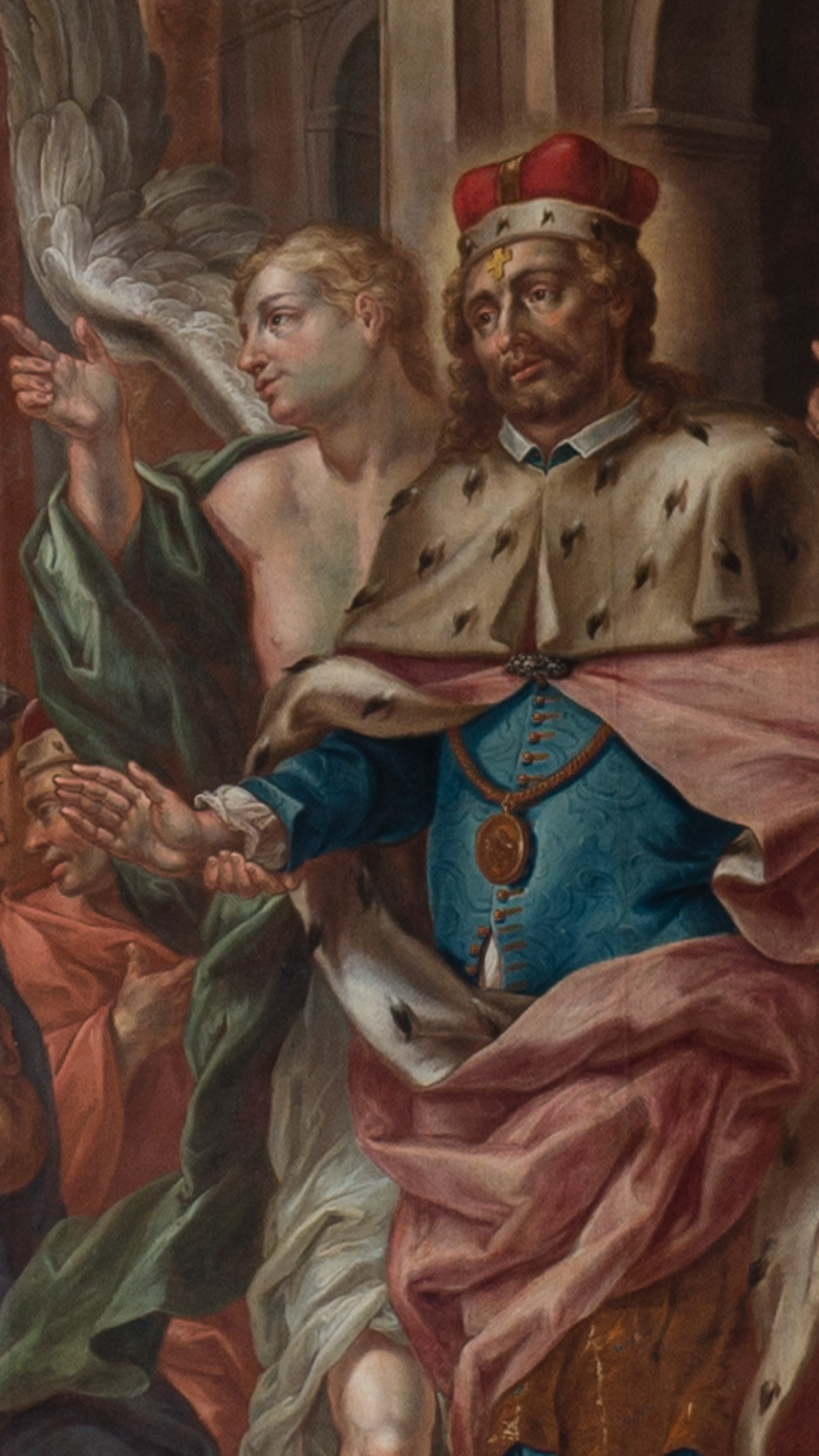
Description: A picture painted on a canvas in the form of a vertically positioned rectangle. The composition depicts St. Wenceslaus, the Czech prince arriving – by the angels who miraculously carried him – before the emperor to the Reich Seym. A multi-figure scene with a crowd of figures shown in various poses and costumes, with a complex composition. The whole thing takes place inside – in a basilica (?) – with monumental forms. On the right (from the viewer’s) side of the composition, in a perspective view, there is successive: a great semicircular arcade, excavated in a wall of considerable thickness (the side walls of this large arcade have architectural divisions, with pilasters and entablature, and with a smaller arcade, on the axis of which above the arch a cartouche with the Přemyslid coat of arms). In the background, a colonnade made of supports with composite capitals, supporting a full entablature and a barrel vault with floral motifs intentionally painted or carved. The interior of this nave is divided by a kind of balcony. In the painting, the left (from the viewer) part of this basilica is invisible because it is covered by the curtains in the foreground, filling the upper left (from the viewer) corner of the painting. Colors of architectural motifs are maintained in shades of gray and brown falling into red; navy blue and white curtains with a brown frame. The described architectural motifs are presented in a completely ahistorical and fantastic way, although in line with the stylistic features of late Baroque architecture. The actual multi-figure scene takes place in the foreground, in front of the arcade leading to the monumental hall. The location of the most important figure of the whole cycle, St. Wenceslaus, marks the ideological center of the composition. In the lower right (viewer’s) corner of the painting, swirling, white-gray, and pink clouds are shown, with three figures facing the axis of the composition. in the center, you can see St. Wenceslaus supported by two angels visible from his sides. The saint, positioned almost 3/4 to the right (heraldic) side, steps forward with his left leg strongly forward. The head is slightly tilted in the same direction as the body is turned. The saint has the face of a mature man, framed by stubble and long hair falling to his shoulders; beard, and brown hair. The saint’s hands are slightly bent at the elbows, lowered to the height of the hips, spread to the sides, with palms open towards the figure on the opposite side of the picture, as if shown in a gesture of refusal. The ruler is dressed in billowing robes revealing his legs to the knees: in turn a white robe (from which only the collar and the end of the right sleeve are visible) and a blue outer robe and a pink ermine-lined cloak with the same cape. Around his neck hangs a long brown (undoubtedly gold) chain with a medallion. On the head, you can see a red miter framed at the bottom with an ermine. One shoe of the saint is visible, low, full, with straight ends. The angels leading the saint and pointing with their fingers to the other part of the composition on the opposite side of the image field (specifically to the emperor there), with young faces, blond hair, are dressed in very tangled robes in white-gray, green and brick red; the robes reveal the arms of the angels, their bare feet. On the back visible large wings set vertically upwards, gray and white. The left, bottom part of the painting is filled with a crowd of about ten dignitaries sitting on benches (one, decorated with volutes, brown, set on a gray floor made of rectangular slabs, visible in the left – from the viewer – corner of the painting). These dignitaries, shown in animated poses, turn toward each other and gesticulate in amazement. They are dressed in rich, multicolored costumes, some wear princely mitres or caps with feathers. They surround a three-step pedestal on which stands the emperor, who is the equivalent of St. Wenceslaus on the other side of the painting. Visible from the right profile, leaning towards St. Wenceslaus, with his head slightly tilted towards the viewer, with his face framed by stubble and hair, with his right arm bent at the elbow, extended forward and holding a bronze (intentionally gold) scepter away from the body, directed towards St. Wenceslaus; the emperor’s left hand visible in the depths, lower, moved to the side from the body. A ruler dressed in armor and a tangled brown cloak decorated with gemstones at the edges. On the emperor’s head, there is a closed crown with four bows, with a ball with a cross on top, richly decorated.
History: The painting belongs to the series placed on the walls of the nave dedicated to two saint patrons of the church (and at the same time the patrons of the countries they came from): Stanislaus, the bishop of Cracow, and a martyr, and Wenceslaus, the Czech prince and also a martyr. Discussed painting wasn’t hung on the wall of the nave until 1725. We know this from the inscription on the wall (on the plaster) behind the painting. However, it cannot be ruled out that the painting itself was created earlier, around 1720, when – as we know from sources its creator, Jeremias Joseph Knechtl, was paid to paint the last works in the series. The execution of the richly decorated frame for this work could take even several years. All these works were financed by the town hall of Świdnica.
Characteristics: The decision to make large paintings illustrating the lives of its patrons for the church in Świdnica was obvious due to the lively liturgical cult of the saints mentioned in this church. The painting discussed here owed its construction to the funds of the city of Świdnica, whose administrators thus manifested their attachment to the Catholic religion. The painting, like two others referring to St. Wenceslaus, has so far not been fully accurately interpreted. The presence in the scene of the emperor extending his scepter towards St. Wenceslaus prompted researchers to define the representation as an illustration of the scene of St. Wenceslaus receiving royal dignity from the hands of the emperor. It was forgotten, however, that the patron of Bohemia never received the royal dignity. The scene depicts the moment of the miraculous arrival of the late Czech prince to the session of the Reichstag and his welcome by the emperor.
Bibliografia
Hermann Hoffmann, Die katholische Pfarrkirche in Schweidnitz, Schweidnitz 1930, s. 12-13.
Danuta Hanulanka, Świdnica, Wydanie II poprawione i uzupełnione, [seria: „Śląsk w Zabytkach Sztuki”, pod redakcją T. Broniewskiego i M. Zlata], Wrocław-Warszawa-Kraków-Gdańsk 1973, s. 93
Edmund Nawrocki, Kościół parafialny św. Stanisława i św. Wacława w Świdnicy. Przewodnik, Świdnica 1990, s. 23
Dariusz Galewski, Kościół Jezuitów w Świdnicy na tle pozostałych gotyckich świątyń prowincji czeskiej Towarzystwa Jezusowego [w:] Śląsk i Czechy. Wspólne drogi sztuki, Materiały konferencji naukowej dedykowane Profesorowi Janowi Wrabecowi, [seria: „Acta Universitatis Wratislaviensis” No 2953, „Historia Sztuki” XXIV], Wrocław 2007, s. 257 i przypis 29
Sobiesław Nowotny, Przewodnik po świdnickiej katedrze, Autor zdjęć Mariusz Barcicki, Świdnica 2009, s. 67 i 70
Dariusz Galewski, Jezuici wobec tradycji średniowiecznej. Barokizacje kościołów w Kłodzku, Świdnicy, Jeleniej Górze i Żaganiu, [seria: „Ars Vetus et Nova”, Redaktor serii W. Bałus, T. XXXVI], Kraków 2012, s. 194 i 222 oraz tamże przypisy 29 i 30 (określenie ikonografii dzieła jak we wcześniejszej pracy autora).
Jeremias Joseph Knechtel (1679-1750). Legnicki malarz doby baroku, Pod redakcją Andrzeja Kozieła i Emilii Kłody, [katalog wystawy], Muzeum Miedzi w Legnicy, Akademia Rycerska, październik 2012 – kwiecień 2013, Legnica 2012, poz. kat. A.100 na s. 194, il. na s. 196; tekst ogólny omawiający oba cykle – s. 194-198, kompletne zestawienie literatury do obrazów z obu cykli – s. 194 – teksty opr. Emilia Kłoda.
Barbara Skoczylas-Stadnik [tekst], Franciszek Grzywacz [fotografie], Katedra świdnicka perłą Dolnego Śląska, Legnica 2016, s. 39, il. na s. 38.
Malarstwo barokowe na Śląsku, pod redakcją Andrzeja Kozieła, Wrocław 2017, s. 488 (autorka noty poświęconej malarzowi Jeremiasowi Josephowi Knechtlowi: Emilia Kłoda).
Sobiesław Nowotny, Herby na ramach wielkich obrazów w nawie głównej świdnickiej katedry, Świdnica 2021, opracowanie historyczne w Archiwum Firmy Konserwatorskiej Piotr Białko w Krakowie [wydruk].