St. Stanislaus Kostka
The Author Jeremias Joseph Knechtel
Date of creation painting 1700, frame 1710
Dimensions The painting - height 212 cm, width 167 cm Frame - height 478 cm, width 327 cm
Material / Technique canvas carpentry and woodcarving techniques colored primer gilding oil technique polished primer wood
Exposure location Main Nave southern wall over the fifth pillar of the inter-nave arcade going from the east


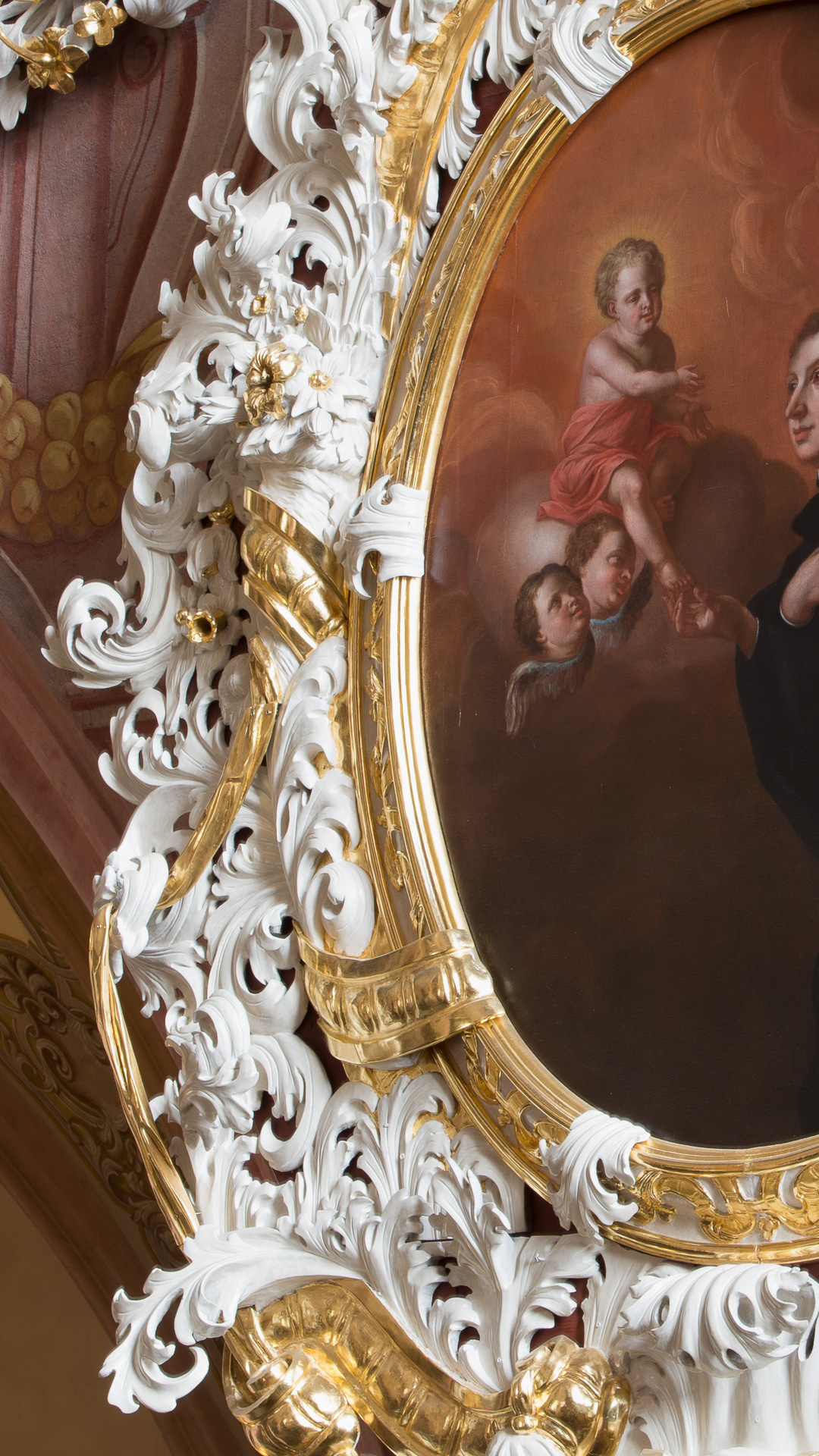


Description:The oval image contains a representation of the vision of St. Stanislaus Kostka, to whom the Child Jesus appears during prayer. The brown background of the representation, mostly uniform (“abstract”), in the upper part, especially on the left side of the composition, takes the form of slightly pink, illuminated clouds, lightened with white. St. Stanislaus is depicted in the right (looking from the viewer) half of the composition, kneeling and facing the heraldic right, shown from the knees, with his head slightly raised, with his right hand folded on his chest and his left hand extended forward. With his fingertips, the saint touches the foot of the right foot of Child, visible in the second half of the image, at the top, against the background of illuminated clouds. The face of a youthful saint, with delicate, rounded features, with a prominent nose; short, thick, dark (brown) hair surrounding the head; rather plump hands; white body complexion. Stanislaus Kostka wearing a black Jesuit habit, with his collar open at the neck, revealing a similarly open white shirt collar; hems of the undergarment are visible also at the ends of the long and narrow sleeves of the habit. In the left half of the picture, at the top, the Child is shown in full form, sitting on the clouds, facing the saint, with his right leg and hands extended towards him. Child’s face with almost “adult”, though delicate features, head framed by short blond hair, and a pale pink complexion. The naked body of little Jesus is covered with a dark pink drapery around the waist; below Infant’s feet, a pair of winged angel heads (gray-blue wings) is visible. Partially openwork frame. In the general outline of an oval, slightly elongated on the vertical axis. At the top, the decoration of the frame is a bit more elaborate, it has the character of a finial, on the axis of which, directly above the painting, a large shell is placed. The frame is cut straight from the bottom. Constructed of symmetrical, multi-layered weaves of acanthus flagellum in the white color of the polished ground, with a sharp styling (but not yet withering) and finer floral motifs and cornucopias on the sides of the frame. The described weaves are enriched with motifs wholly or partly gold: profiled slats, sections of a gathered ribbon of various widths, mostly twisted (with volute endings), independent volutes, lily flowers, and a horn, e.g. with large flower calyxes in the upper projection (at the top of the frame).
Provenance: The painting belongs to a series of nine compositions funded by the Świdnica Jesuits as part of the baroqueization of the Gothic interior of the church in Świdnica, which lasted several decades. The paintings were commissioned in 1700 by two Silesian painters: four from Knechtl and five from Johann Jacob Eybelwieser the Younger. Knechtel probably painted his paintings quite quickly, but the rich frames for them were made ten years later, probably only when all the paintings in the cycle were ready.
Characteristics: The painting belongs to a series that was intended to illustrate the merits of the Jesuits in the history of the Catholic Church by showing the most outstanding representatives of the order. Among them stood out two very young Jesuits who were not martyrs, but extremely zealous believers. Next to the Italian, St. Alojzy Gonzaga, whose image was also included in the Świdnica series, the Pole St. Stanislaus Kostka, born in 1550 in Mazovia as the son of the castellan of Zakroczym, Jan. As a boy he was sent to study in Vienna, where he studied under the supervision of the Jesuits. His increased religiosity quickly manifested itself, strengthened by a mystical experience he had during his illness in 1565. Stanislaus quickly decided – against his father’s position – to join the new order and in 1567 he reached Rome through Bavaria, where Francis Borgias directed him to the novitiate at the church of St. Andrew at the Quirinal. There, shortly afterward, on August 15, 1568, Stanislaus died of malaria. In the opinion of his contemporaries, he had exceptional qualities of character and died in an aura of holiness. Beatified in 1606, he was canonized in 1726. Its representation in the cycle of Świdnica paintings consciously brings it closer to the image of St. Alojzy Gonzaga. The painting belongs to the early period of Knechtl’s work and some echoes of mannerist solutions can still be seen in the composition of the performance. However, in this case, the shot is very calm, and Knechtel put the emphasis primarily on the illustration of the deep spiritual life of the saint.
Bibliografia
Edmund Nawrocki, Kościół parafialny św. Stanisława i św. Wacława w Świdnicy. Przewodnik, Świdnica 1990, s. 23.
Henryk Fros SJ, Święci i błogosławieni Towarzystwa Jezusowego, Kraków 1992, s. 25-27 [tylko do ikonografii – nie zawiera wzmianki o obrazie ze Świdnicy].
Rainer Sachs, Teresa Sokół, Życie i twórczość rzeźbiarza Tobiasa Franza Stallmeyera (1673-1747), [w:] Dziedzictwo artystyczne Świdnicy, Pod redakcją Bogusława Czechowicza, [Książka zawiera materiały z sesji naukowej odbytej w Świdnicy w dniu 2 czerwca 2000 roku], Wrocław- Świdnica 2003, s. 150 i 152.
Dariusz Galewski, Jezuici wobec tradycji średniowiecznej. Barokizacje kościołów w Kłodzku, Świdnicy, Jeleniej Górze i Żaganiu, Kraków 2012 (Ars Vetus et Nova, Redaktor serii Wojciech Bałus, T. XXXVI), przypis 28 na s. 222.
Jeremias Joseph Knechtel (1679-1750). Legnicki malarz doby baroku, Pod redakcją Andrzeja Kozieła i Emilii Kłody, [katalog wystawy], Muzeum Miedzi w Legnicy, Akademia Rycerska, październik 2012 – kwiecień 2013, Legnica 2012, poz. kat. A.91-94 na s. 190-192 (noty opr. Emilia Kłoda), il. A.92 na s. 191; na s. 190 zebrana pełna literatura przedmiotu.
Barbara Skoczylas-Stadnik [tekst], Franciszek Grzywacz [fotografie], Katedra świdnicka perłą Dolnego Śląska, Legnica 2016, s. 43.
Malarstwo barokowe na Śląsku, pod redakcją Andrzeja Kozieła, Wrocław 2017, s. 488 (autorka noty poświęconej malarzowi: Emilia Kłoda).