St. Stanislaus distributes alms
Date of creation 1711
Dimensions height 587 cm, width 416 cm
Material / Technique canvas colored primer oil technique
Exposure location Main Nave northern wall over the fifth inter-nave arcade going from the east

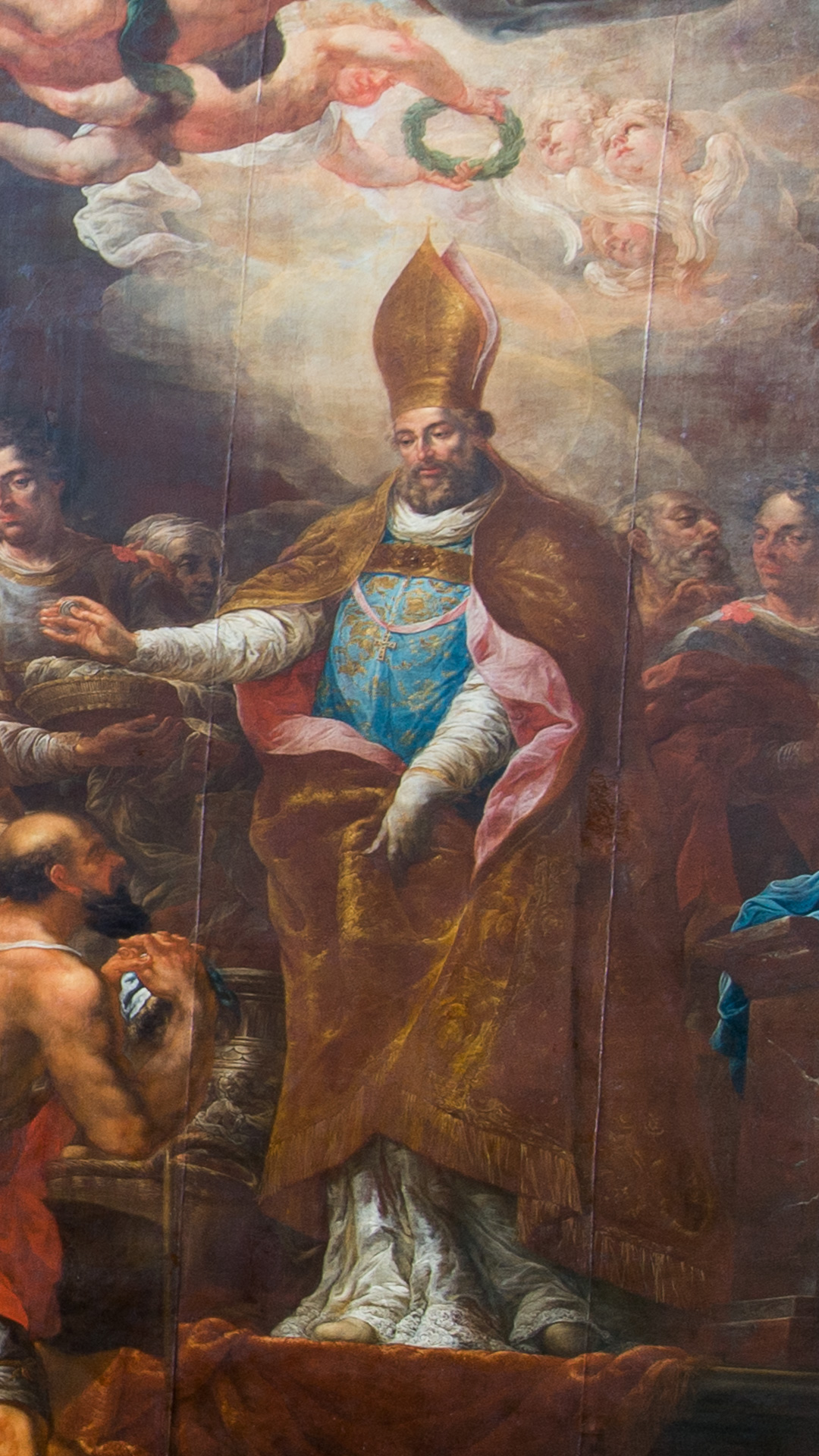


Description: A picture painted on a canvas in the form of a vertically positioned rectangle. The composition depicts St. Stanislaus, Bishop of Krakow, distributing alms to the poor. A multi-figure scene with a complex composition (which is particularly visible on the heraldically right side of the painting). The whole thing takes place against a background filled with architectural elements partially obscured by clouds. In the central part, on the right side of the painting, on a raised platform, the most important figure of the composition is depicted – St. Stanislaus. Shown in full form, with a massive posture, he stands slightly turned to the right (heraldically) side, towards a group of figures filling the left half of the composition (from the viewer). The saint’s head is also turned slightly in the same direction. His face has the features of an older man, framed by brown stubble with a medium-length beard, and locks of hair of the same color are visible on the sides of his head. The saint has his right hand extended towards the poor, the hand is already visible within this group. He holds the left coverlet at the height of the right thigh, pressing the open book to his body and pointing to its page with his finger. The saint is dressed in a bishop’s outfit: a white alb, a blue chasuble, and a brown cope, a white amice is visible at the neck. The saint has a pectoral cross around his neck and a brown and gold miter on his head. The folds of the saint’s robes are dynamic, treated in a summary way, not in detail. Near the right edge of the field of the picture, as if behind the back of Saint a group of figures assisting him, with a young clergyman holding a crosier visible closest to him. The group of the poor depicted within the same plan as the bishop, opposite him, a little lower, consists of men and women; in this group, at the left edge of the image field, there is a mother with a child in her arms, and in the center of the whole group there is another, more grown child. At the top of the group, a man in a dalmatic accompanying the bishop, with his head turned towards the figures below. With both hands, he holds a flat dish with gifts. Behind it emerges two people, only their heads are visible. All the figures awaiting gifts are turned towards St. Stanislaus. The poses of the depicted people are varied: the poor ones depicted in the upper part are standing, an elderly man visible in full form at the left edge of the painting with his knees bent, while the elderly men at the bottom – and certainly one of them depicted in the foreground at the lowest position – is kneeling. People imagined in this group of different ages, types, facial features, and gestures – some fold their hands pleadingly, and others stretch them out to the saint. All the poor dressed in “timeless” clothes and wrapped in draperies, figures in the foreground with bare feet and weathered legs exposed to the knees. Parts of their clothing are monochromatic (blue, red, brown) unlike the richer fabrics of clerical clothing. The background of the painting is filled with brown elements of architecture: a monumental curly column and walls. In the foreground, near the right edge of the painting, in the lower half of the field, there is a pedestal with a blue drapery. A large part of the background is occupied by a white-brown sky with clouds, white and blue draperies are also hung there. Against the background of the sky and draperies, there are flying angels on the axis of the painting, their hips wrapped in blue and green shawls. One is holding St. Stanislaus green laurel wreath. The other supports the blue curtain so that it does not fall and obscure the depicted scene.
History: The painting belongs to the series placed on the walls of the nave dedicated to two saint patrons of the church (and at the same time the patrons of the countries they came from): Stanislaus, the bishop of Krakow, and a martyr, and Wenceslaus, the Czech prince and also a martyr. The painting presented here is framed with a cartouche at the bottom, in which the coat of arms of the founder, Johann Anton von Schaffgotsch, and the date “1711” are displayed in the main place. The significance of this monument is because the frame of the painting – only once in the whole series – bears the date of foundation of the work. We can assume that it was the earliest (probably after the painting made by the Jesuits with their funds) work in the series and perhaps, as a foundation of one of the most powerful Silesian aristocrats, it was supposed to encourage other potential donors.
Characteristics: The decision to make large paintings illustrating the lives of its patrons for the church in Świdnica was obvious due to the lively liturgical cult of the saints mentioned in this church. Due to financial difficulties, the Jesuits, unable to commission all the necessary works, funded – perhaps – only one painting (Saint Stanislaus casting a curse on King Boleslaw the Bold). Among the others, two were commissioned by the clergy, while others were financed by representatives of the Silesian aristocracy, but also by the townspeople of Świdnica. Johann Anton von Schaffgotsch (1675-1742), count, follower, and associate of Habsburg, a long-time starost of the Duchy of Świdnica-Jawor on behalf of the emperors, and finally a knight of the Order of the Golden Fleece, was undoubtedly the most powerful, richest and most famous of the founders of the paintings from the discussed group. The iconography of the work and its authorship also require a short commentary. The subject of the painting seems particularly close to the Polish viewer, but it must be remembered that the cult of St. Stanislaus in Silesia has been very active since the Middle Ages, also after the separation of this district from the Polish state in the fourteenth century. Therefore, the iconographic approach used in this painting does not differ much from the implementation of this theme known in Polish art. Of course, the artistic form is closely related to Baroque Silesian painting, and not to Polish art. In the existing literature, the painting was considered to be the work of Jeremias Joseph Knechtl – similar to all other paintings from this series. However, recently Emilia Kłoda, a researcher of the work of the painter from Legnica, noticed that one of the works from this series, the painting The Poor, pays homage to St. Wenceslaus’s painting differs so much from Knechtl’s works that it must be a painting by another artist, unknown to us so far. It seems that the case of the authorship of the painting of St. Stanislaus distributes alms, which differs in style from Knechtl’s works, and brings it closer to the image excluded from his work by Emilia Kłoda. Therefore, a hypothesis should be put forward that two paintings from a series dedicated to the patrons of the temple were made by an unknown Silesian artist. The issue requires further research.
Bibliografia
Hermann Hoffmann, Die katholische Pfarrkirche in Schweidnitz, Schweidnitz 1930, s. 12-13.
Danuta Hanulanka, Świdnica, Wydanie II poprawione i uzupełnione, [seria: „Śląsk w Zabytkach Sztuki”, pod redakcją T. Broniewskiego i M. Zlata], Wrocław-Warszawa-Kraków-Gdańsk 1973, s. 93
Edmund Nawrocki, Kościół parafialny św. Stanisława i św. Wacława w Świdnicy. Przewodnik, Świdnica 1990, s. 23
Dariusz Galewski, Kościół Jezuitów w Świdnicy na tle pozostałych gotyckich świątyń prowincji czeskiej Towarzystwa Jezusowego [w:] Śląsk i Czechy. Wspólne drogi sztuki, Materiały konferencji naukowej dedykowane Profesorowi Janowi Wrabecowi, [seria: „Acta Universitatis Wratislaviensis” No 2953, „Historia Sztuki” XXIV], Wrocław 2007, s. 257 i przypis 29.
Sobiesław Nowotny, Przewodnik po świdnickiej katedrze, Autor zdjęć Mariusz Barcicki, Świdnica 2009, s. 67 i 70.
Dariusz Galewski, Jezuici wobec tradycji średniowiecznej. Barokizacje kościołów w Kłodzku, Świdnicy, Jeleniej Górze i Żaganiu, [seria: „Ars Vetus et Nova”, Redaktor serii W. Bałus, T. XXXVI], Kraków 2012, s. 194 i 222 oraz tamże przypisy 29 i 30.
Jeremias Joseph Knechtel (1679-1750). Legnicki malarz doby baroku, Pod redakcją Andrzeja Kozieła i Emilii Kłody, [katalog wystawy], Muzeum Miedzi w Legnicy, Akademia Rycerska, październik 2012 – kwiecień 2013, Legnica 2012, poz. kat. A.96 na s. 192, il. na s. 194 (il. dolna lewa); tekst ogólny omawiający oba cykle – s. 194-198, kompletne zestawienie literatury do obrazów z obu cykli – s. 194 – teksty opr. Emilia Kłoda
Barbara Skoczylas-Stadnik [tekst], Franciszek Grzywacz [fotografie], Katedra świdnicka perłą Dolnego Śląska, Legnica 2016, s. 36, il. lewa na s. 36.
Malarstwo barokowe na Śląsku, pod redakcją Andrzeja Kozieła, Wrocław 2017, s. 488 (autorka noty poświęconej malarzowi Jeremiasowi Josephowi Knechtlowi: Emilia Kłoda; autorka nie podważa autorstwa Knechtla odnośnie tego obrazu).
Sobiesław Nowotny, Herby na ramach wielkich obrazów w nawie głównej świdnickiej katedry, Świdnica 2021, opracowanie historyczne w Archiwum Firmy Konserwatorskiej Piotr Białko w Krakowie [wydruk].