St. Paul
The Author Georg Leonhard Weber
Date of creation 1709-1710
Dimensions height 232 cm
Material / Technique carpentry and woodcarving techniques gilding polished primer in white polychrome wood
Exposure location Main Nave southern wall on the first pillar of the inter-nave arcade going from the east

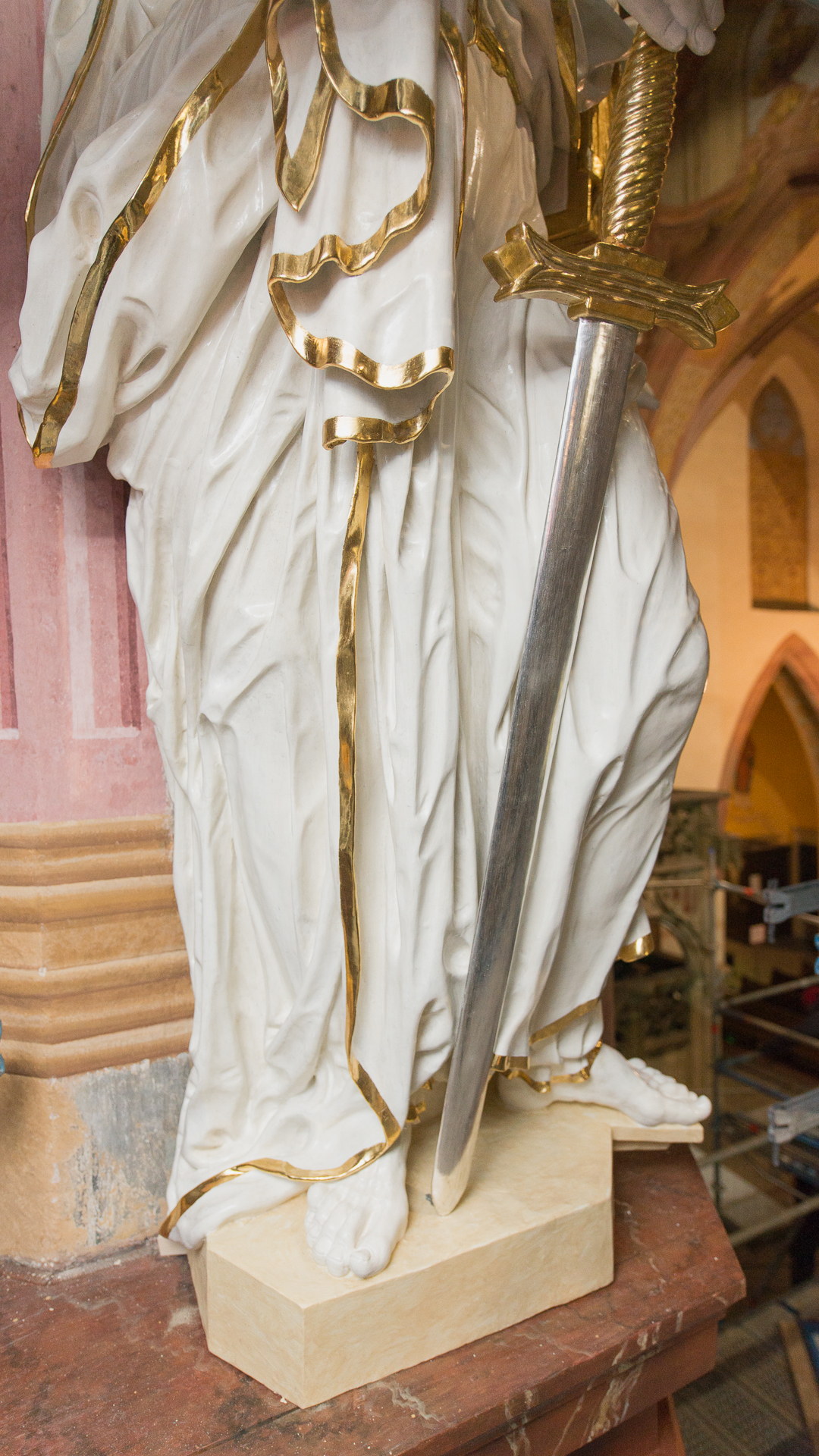


Description: A full-figure, almost full, cut-back and hollow depiction of a standing St. Paul set on a console suspended on a pillar. A prominent console, decorated from the front with a massive volute cartouche preceded from the bottom with a kind of suspended grooved “shell”. Side cartouche decorated with leaves; in its center an oval plaque with a golden inscription on a red background: “In honorem | S. PAULI | apostles.” Above the cartouche, the upper part of the console, polygonal, profiled in the form of a cornice, covered with brown marbling. On the upper surface of the console, there is an additional base for the figure in the form of a thick plate.
The saint is slightly moved, with his whole figure turned slightly to the left (heraldically) side (towards the main nave of the cathedral), with the left leg strongly moved forward, bent at the knee and the right one slightly withdrawn; both feet of the saint are bare. The saint’s head is turned even more in the same direction as his body, very slightly raised. The face is of an elderly man (mouth parted as if speaking), framed by very lush hair in thick curls and stubble with a long beard covering the neck. Paul has his left hand slightly moved away from the body and forward – he is holding a thick book under his armpit; in his right hand visible at the height of his hips Paul is holding the hilt of a massive sword.
The apostle’s robes are of a “timeless” character – a visible undergarment and a kind of cloak tied on the right shoulder. Both garments are arranged dynamically, and very richly folded – which makes it difficult to trace their course and distinguish them from each other. A sculpture in white color of polished primer with small golden elements: on a console with the edges of volute forms of a cartouche and some small leaves; on the robes of the saint with borders; in addition, the book and the hilt of the sword (its blade is silver in color) are gold.
History: The figure is one of nine sculptures of saints placed on the initiative of the Jesuits in 1710 on consoles hung on the pillars of the nave. Each of the sculptures was funded by a different person – the execution of the figure of St. Paul was financed by the provost and dean of Kiełczyn, Christoph Kirschbaum.
Characteristics: To refer to the Catholic, medieval past of Świdnica, the Jesuits decided that each figure would represent the patron of one of the chapels located at the gates leading to the city. The described statue refers to the chapel of St. Peter and St. Paul located at St. Peter’s Gate. St. Paul presented in the figure was the leading saint of the first century of Christianity. Although he was not one of the Apostles or disciples of Christ, he is nevertheless called the Apostle of Nations, because he gave Christianity a universal dimension and laid the intellectual foundations for a new religion. He probably died a martyr’s death in Rome, beheaded with a sword. In the art, he is identifiable due to typical for him physiognomy with a lush and long beard, as well as his attributes that indicate both the wisdom of St. Paul and his martyrdom.
Bibliografia
Hermann Hoffmann, Die Jesuiten in Schweidnitz, Schweidnitz 1930 (Zur Schlesischen Kirchengeschichte, Nr 3), s. 153.
Erich Wiese, Thomas Weisfeldt, ein nordischer Barockbildhauer in Schlesien, „Jahrbuch der Preussischen Kunstsammlungen“, Bd. 55, 1934, s. 79
Edmund Wilhelm Braun, Studien zur schlesischen Barockplastik. II. Die Künstlerische Entwicklung des Schweidnitzer Bildhauers Georg Leonhard Weber bis 1725, „Kunst und Denkmalpflege in Schlesien“, Bd. 2, 1939, s. 128-129
Danuta Ostowska, Jerzy Leonard Weber rzeźbiarz śląski epoki baroku, „Roczniki Sztuki Śląskiej” T. II, 1963, s. 97-98.
Danuta Ostowska, Zespół rzeźbiarski w Konarach, „Roczniki Sztuki Śląskiej, T. IV, 1967, s. 218
Danuta Ostowska, Rzeźba śląska 1650-1770. Katalog wystawy, Muzeum Narodowe we Wrocławiu, Wrocław 1969
Danuta Hanulanka, Świdnica, Wydanie II poprawione i uzupełnione, [seria: „Śląsk w Zabytkach Sztuki”, pod redakcją T. Broniewskiego i M. Zlata], Wrocław-Warszawa-Kraków-Gdańsk 1973, s. 88-89.
Konstanty Kalinowski, Rzeźba barokowa na Śląsku, Warszawa 1986, s. 180-181, przypisy 251-252 na s. 225.
Edmund Nawrocki, Kościół parafialny św. Stanisława i św. Wacława w Świdnicy. Przewodnik, Świdnica 1990, s. 23-24.
Teatr i mistyka. Rzeźba barokowa pomiędzy Zachodem a Wschodem, [katalog wystawy], Poznań, Muzeum Narodowe, czerwiec – sierpień 1993, Katalog pod redakcją Konstantego Kalinowskiego, Poznań 1993, [edycja polsko-angielska], s. I.104 - notę biograficzną Jerzego Leonarda Webera opracował Konstanty Kalinowski
Dariusz Galewski, Kościół Jezuitów w Świdnicy na tle pozostałych gotyckich świątyń prowincji czeskiej Towarzystwa Jezusowego [w:] Śląsk i Czechy. Wspólne drogi sztuki, Materiały konferencji naukowej dedykowane Profesorowi Janowi Wrabecowi, [seria: „Acta Universitatis Wratislaviensis” No 2953, „Historia Sztuki” XXIV], Wrocław 2007, s. 263.
Sobiesław Nowotny, Przewodnik po świdnickiej katedrze, Autor zdjęć Mariusz Barcicki, Świdnica 2009, s. 70-71.
Dariusz Galewski, Jezuici wobec tradycji średniowiecznej. Barokizacje kościołów w Kłodzku, Świdnicy, Jeleniej Górze i Żaganiu, [seria: „Ars Vetus et Nova”, Redaktor serii W. Bałus, T. XXXVI], Kraków 2012, s. 195 i 222.
Barbara Skoczylas-Stadnik [tekst], Franciszek Grzywacz [fotografie], Katedra świdnicka perłą Dolnego Śląska, Legnica 2016, s. 32 i 34-35 (il. z podpisami), figura Św. Pawła – il. górna lewa na s. 34.
Artur Kolbiarz, Michael Klahr Starszy, Paul Stralano i rzeźba barokowa w Świdnicy. Nowe uwagi na temat edukacji artystycznej Klahra, „Roczniki Sztuki Śląskiej”, T. XXVII, 2018, s. 147