St. Paul Miki
The Author Jeremias Joseph Knechtel
Date of creation painting 1700, frame 1710
Dimensions "The painting - height 218 cm, width 174 cm Frame - height 486 cm, width 328 cm"
Material / Technique canvas carpentry and woodcarving techniques colored primer gilding oil technique polished primer wood
Exposure location Main Nave northern wall over the fourth pillar of the inter-nave arcade going from the east


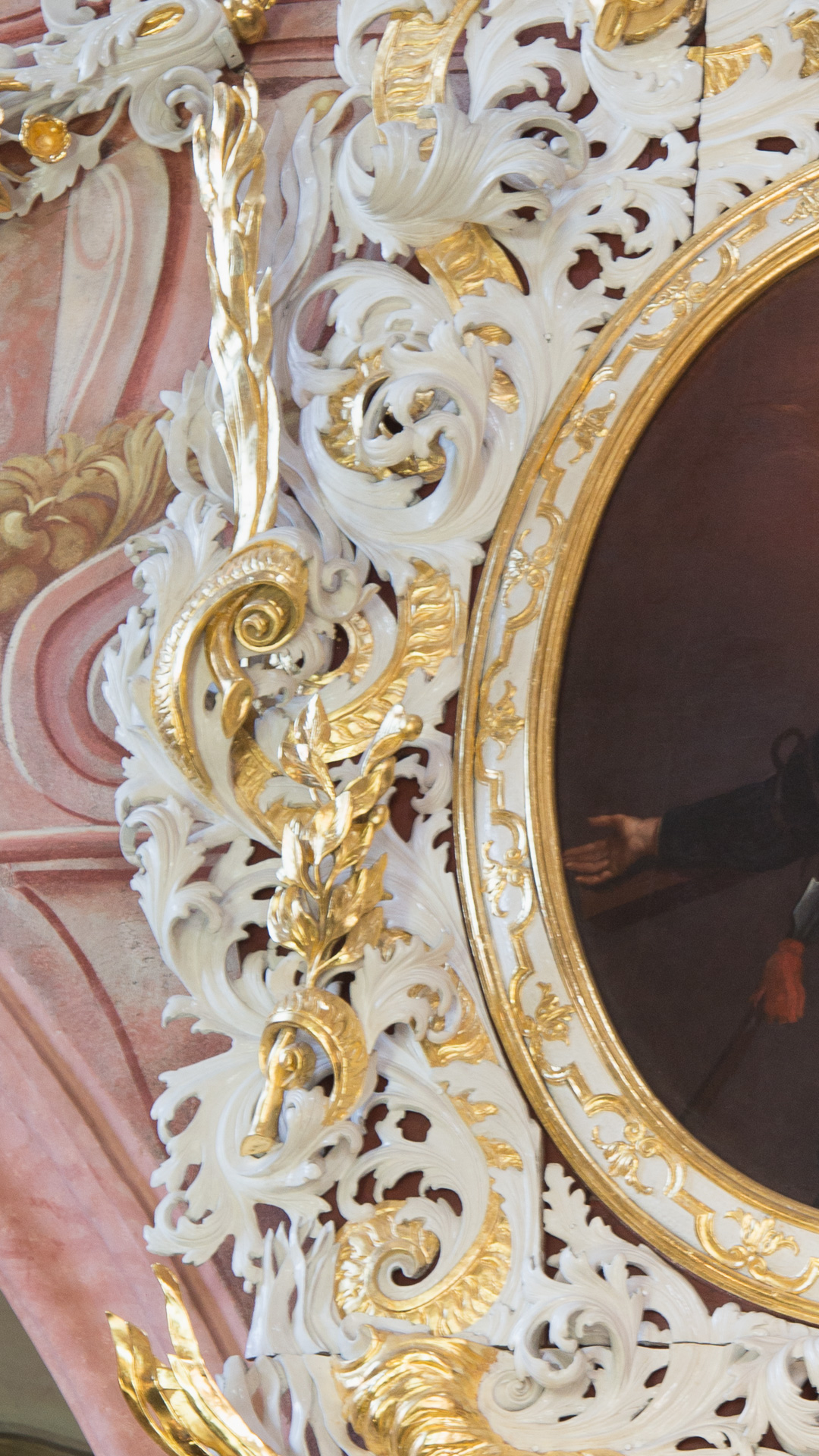

Description: The oval image contains a depiction of St. Paul Miki shown at the moment of martyrdom. The saint is depicted from the knees, tied with ropes in a vertical position to a brown cross, poorly distinguishable from the background, with his arms spread wide, with his head slightly raised to the left (heraldically). He has the face of a middle-aged man with short, graying hair and stubble with a short beard, and eyes upturned. The saint’s individually characterized face is emphasized by deep shadows. He is wearing a long-sleeved black religious habit and a white robe underneath, with visible sleeves and a collar. His torso is pierced by two spears pointing diagonally from below, partially visible, gray and black, with dark red fringes at the bases of the blades: profuse traces of blood are visible on the habit. The background of the representation is mostly dark red, with a brown tint, with visible outlines of clouds and rays of light. Against the background in the upper part of the painting, a flying angel is shown, covered with red drapery, holding a dark green martyr’s palm and a wreath. Partially openwork frame. It has the general outline of an oval, slightly elongated on the vertical axis (slightly more from the top, where it has the character of a finial, on the axis of which a partially golden crown is depicted with the upper part made of white acanthus leaves, above which, almost at the very top of the frame, is a golden volute). The frame is straight cut at the bottom. Constructed of symmetrical, multi-layer weaves of acanthus flagella in the white color of polished primer, with a sharp styling (but not yet withering) enriched with golden motifs: sections of a gathered ribbon, usually twisted (with volute endings), palm leaves and laurel branches, broken ribbon and campanulas (the last two motifs on the frame directly enclosing the painting) and cornucopias (in the lower part of the frame).
History: The painting belongs to a series of nine compositions funded by the Świdnica Jesuits as part of the thorough baroqueization of the Gothic interior of the church in Świdnica, which lasted several decades. The paintings were commissioned in 1700 by two Silesian painters: four from Knechtl and five from Johann Jacob Eybelwieser the Younger. Knechtel, who received a total of 60 florins for his works, probably painted the pictures quite quickly, but the rich frames for them were made ten years later, undoubtedly in connection with the work on the huge elements of the temple’s furnishings, carried out at the same time, by a woodcarving workshop organized on the spot by the Jesuits.
Characteristics: The painting belongs to a series that was intended to illustrate the merits of the Jesuits in the history of the Catholic Church by showing the most outstanding representatives of the Order, especially the martyrs who lost their lives during the Jesuit missions in the East. Some of the older literature incorrectly identifies the hero of the composition as St. John Francis Régis (or as St. John of Goto). Meanwhile, St. Paul Miki, a Japanese born around 1565 near Kyoto, was in a family of high social status, but leaning towards Catholicism. Baptized as a child, and educated by the Jesuits, he joined them as a boy, and as an adult, he became an outstanding catechist – he was destined to be ordained a priest (which was rare in the case of the Japanese). As one of many Jesuits, he became a victim of persecution in the final years of the 16th century. He has ordained a priest in prison, and on February 5, 1597, after torture, he was martyred (with a total of twenty-six Christians) near Nagasaki (crucified and pierced with lances). He was beatified by Pope Urban VIII in 1627 and canonized by Pope Pius IX in 1862. The theme of the Jesuit martyrs must have been close to the author of the painting, Jeremias Joseph Knechtl, who – probably after studying in Prague – settled in Legnica and became primarily associated with this order. The painting belongs to the early period of his work, in which some echoes of mannerist solutions can still be seen. The composition, despite its dramatic theme, does not dazzle with cruelty or excessive expression, its author rather emphasized the calm certainty of faith, which is depicted in the saint’s face at the moment of death.
Bibliografia
Edmund Nawrocki, Kościół parafialny św. Stanisława i św. Wacława w Świdnicy. Przewodnik, Świdnica 1990, s. 23 [błędnie jako przedstawienie św. Jana Franciszka Régis].
Henryk Fros SJ, Święci i błogosławieni Towarzystwa Jezusowego, Kraków 1992, s. 68-69 [tylko do ikonografii – nie zawiera wzmianki o obrazie ze Świdnicy].
Rainer Sachs, Teresa Sokół, Życie i twórczość rzeźbiarza Tobiasa Franza Stallmeyera (1673-1747), [w:] Dziedzictwo artystyczne Świdnicy, Pod redakcją Bogusława Czechowicza, [Książka zawiera materiały z sesji naukowej odbytej w Świdnicy w dniu 2 czerwca 2000 roku], Wrocław- Świdnica 2003, s. 150 i 152.
Dariusz Galewski, Jezuici wobec tradycji średniowiecznej. Barokizacje kościołów w Kłodzku, Świdnicy, Jeleniej Górze i Żaganiu, Kraków 2012 (Ars Vetus et Nova, Redaktor serii Wojciech Bałus, T. XXXVI), przypis 28 na s. 222 [błędnie jako przedstawienie św. Jana Franciszka Régis].
Jeremias Joseph Knechtel (1679-1750). Legnicki malarz doby baroku, Pod redakcją Andrzeja Kozieła i Emilii Kłody, [katalog wystawy], Muzeum Miedzi w Legnicy, Akademia Rycerska, październik 2012 – kwiecień 2013, Legnica 2012, poz. kat. A.91-94 na s. 190-192 (noty opr. Emilia Kłoda), il. A.93 na s. 191; na s. 190 zebrana pełna literatura przedmiotu.
Barbara Skoczylas-Stadnik [tekst], Franciszek Grzywacz [fotografie], Katedra świdnicka perłą Dolnego Śląska, Legnica 2016, s. 40.
Sobiesław Nowotny, Niezwykłe odkrycie w świdnickiej katedrze, „Wiadomości Świdnickie”, Nr 27, 6-12.07.2015 r., s. 14 [błędnie jako przedstawienie św. Jana z Goto].
Malarstwo barokowe na Śląsku, pod redakcją Andrzeja Kozieła, Wrocław 2017, s. 488 (autorka noty poświęconej malarzowi: Emilia Kłoda).