St. Lawrence
The Author Georg Leonhard Weber
Date of creation 1709-1710
Dimensions height 229 cm
Material / Technique carpentry and woodcarving techniques gilding polished primer in white polychrome wood
Exposure location Main Nave southern wall on the fourth pillar of the inter-nave arcade going from the east

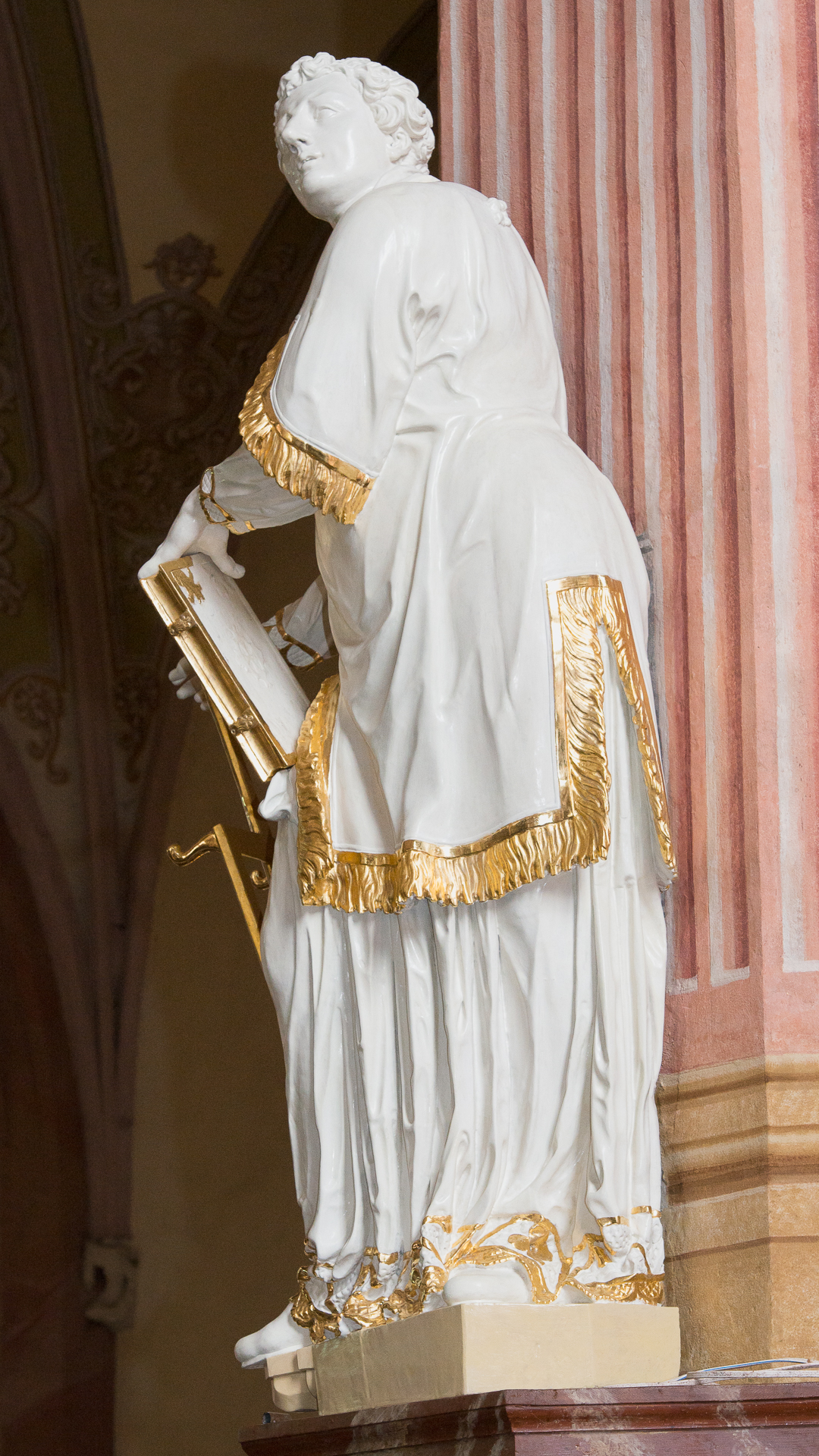


Description: A full-figure, almost full, cut-back and hollow depiction of a standing St. Lawrence set on a console suspended on a pillar. A prominent console, decorated from the front with a massive volute cartouche preceded from the bottom with a kind of suspended grooved “shell”. Side cartouche decorated with leaves; in its center an oval plaque with a golden inscription on a red background: “In honorem | S. LAURENTI | Mart.”. Above the cartouche, the upper part of the console, polygonal, profiled in the form of a cornice, covered with brown marbling. On the upper surface of the console, there is an additional base for the figure in the form of a thick plate. Saint is in a dynamic pose, strongly bent at the hips to the left (heraldically) side, with the right leg strongly advanced, bent at the knee, and with the left one withdrawn, practically invisible under the robes (except for the tip of the shoe); full boots visible on both feet. The saint’s head is turned in the same direction as his hips, raised, and turned three-quarters away from the viewer. The smooth, beardless face of a young man with full, slightly plump features. relatively short and strongly curled hair. The saint’s arms are bent at the elbows and directed to the heraldic right. Hands at the height of the hips: the right hand moved to the side from the body, holds the grate handle and the left one is visible slightly higher than the right one, against the background of the figure. The saint holds the upper edge of a book (undoubtedly the Gospel) with his left hand and the lower edge of the book rests on his right thigh. Book’s binding with decorative fittings at the edges, in the corners, and the middle of the cover. Lawrence is dressed as a deacon – he is wearing an alb, a dalmatic, and a humeral around his neck. The robes are folded in many places, e.g. at the bottom of the figure – strongly, with small folds; in other places with large smooth surfaces. Next to the saint’s right leg, resting on the base of the sculpture, there is an instrument of Lawrence’s martyrdom: a grate (with simplified forms and the handle directed upwards). The sculpture is in a white color of polished primer with small golden elements: on a console with the edges of volute forms of a cartouche and some small leaves; on the saint’s robes with alb frames at the bottom and decorations on the sleeves, dalmatic hems and some elements of the humeral; moreover, the grate and the fittings of the book are gold.
History: The figure is one of the nine sculptures of saints placed on the initiative of the Jesuits in 1710 on consoles hung on the pillars of the nave. Each of the sculptures was funded by a different person – the execution of the figure of St. Lawrence was financed by a juror of Świdnica Nikolaus Hada, in memory of the chapel dedicated to this saint at the Lower Gate.
Characteristics: To refer to the Catholic, medieval past of Świdnica, the Jesuits decided that each figure would represent the patron of one of the chapels located at the gates leading to the city. One of the most popular patron saints of these small temples, which was already popular in the Middle Ages, was St. Lawrence (225-258). Although he lived relatively early in history, the fact that he was active in Rome means that we know a lot of details about his life. Born in Spain, as a young man he met the future Pope Sixtus II, and together they traveled to Rome. When Sixtus took the papal throne, he appointed the still-young Lawrence a deacon and elevated him above other Roman deacons. During the persecution of Christians under the emperor Valerian, the pope was executed, and from Lawrence, who replaced him, imperial officials demanded to surrender the treasures of the Church. Lawrence quickly got rid of the valuables and distributed them to the poor and beggars, and as a punishment, he suffered a martyr’s death on the grate above the hearth. That is why the grate, as well as the characteristic deacon’s outfit, became his attributes.
Bibliografia
Hermann Hoffmann, Die Jesuiten in Schweidnitz, Schweidnitz 1930 (Zur Schlesischen Kirchengeschichte, Nr 3), s. 153.
Erich Wiese, Thomas Weisfeldt, ein nordischer Barockbildhauer in Schlesien, „Jahrbuch der Preussischen Kunstsammlungen“, Bd. 55, 1934, s. 79
Edmund Wilhelm Braun, Studien zur schlesischen Barockplastik. II. Die Künstlerische Entwicklung des Schweidnitzer Bildhauers Georg Leonhard Weber bis 1725, „Kunst und Denkmalpflege in Schlesien“, Bd. 2, 1939, s. 128-129
Danuta Ostowska, Jerzy Leonard Weber rzeźbiarz śląski epoki baroku, „Roczniki Sztuki Śląskiej” T. II, 1963, s. 97-98.
Danuta Ostowska, Zespół rzeźbiarski w Konarach, „Roczniki Sztuki Śląskiej, T. IV, 1967, s. 218
Danuta Ostowska, Rzeźba śląska 1650-1770. Katalog wystawy, Muzeum Narodowe we Wrocławiu, Wrocław 1969
Danuta Hanulanka, Świdnica, Wydanie II poprawione i uzupełnione, [seria: „Śląsk w Zabytkach Sztuki”, pod redakcją T. Broniewskiego i M. Zlata], Wrocław-Warszawa-Kraków-Gdańsk 1973, s. 88-89.
Konstanty Kalinowski, Rzeźba barokowa na Śląsku, Warszawa 1986, s. 180-181, przypisy 251-252 na s. 225.
Edmund Nawrocki, Kościół parafialny św. Stanisława i św. Wacława w Świdnicy. Przewodnik, Świdnica 1990, s. 23-24.
Teatr i mistyka. Rzeźba barokowa pomiędzy Zachodem a Wschodem, [katalog wystawy], Poznań, Muzeum Narodowe, czerwiec – sierpień 1993, Katalog pod redakcją Konstantego Kalinowskiego, Poznań 1993, [edycja polsko-angielska], s. I.104 - notę biograficzną Jerzego Leonarda Webera opracował Konstanty Kalinowski
Dariusz Galewski, Kościół Jezuitów w Świdnicy na tle pozostałych gotyckich świątyń prowincji czeskiej Towarzystwa Jezusowego [w:] Śląsk i Czechy. Wspólne drogi sztuki, Materiały konferencji naukowej dedykowane Profesorowi Janowi Wrabecowi, [seria: „Acta Universitatis Wratislaviensis” No 2953, „Historia Sztuki” XXIV], Wrocław 2007, s. 263.
Sobiesław Nowotny, Przewodnik po świdnickiej katedrze, Autor zdjęć Mariusz Barcicki, Świdnica 2009, s. 70-71.
Dariusz Galewski, Jezuici wobec tradycji średniowiecznej. Barokizacje kościołów w Kłodzku, Świdnicy, Jeleniej Górze i Żaganiu, [seria: „Ars Vetus et Nova”, Redaktor serii W. Bałus, T. XXXVI], Kraków 2012, s. 195 i 222.
Barbara Skoczylas-Stadnik [tekst], Franciszek Grzywacz [fotografie], Katedra świdnicka perłą Dolnego Śląska, Legnica 2016, s. 32 i 34-35 (il. z podpisami), figura Św. Wawrzyńca – il. górna środkowa na s. 34.
Artur Kolbiarz, Michael Klahr Starszy, Paul Stralano i rzeźba barokowa w Świdnicy. Nowe uwagi na temat edukacji artystycznej Klahra, „Roczniki Sztuki Śląskiej”, T. XXVII, 2018, s. 147