St. Francis Xavier
The Author Johann Jacob Eybelwieser the Younger
Date of creation painting and frame 1710
Dimensions The painting - height 219 cm, width 167 cm Frame - height 435 cm, width 315 cm
Material / Technique canvas carpentry and woodcarving techniques colored primer gilding oil technique polished primer wood
Exposure location Main Nave southern wall over the second pillar of the inter-nave arcade going from the east

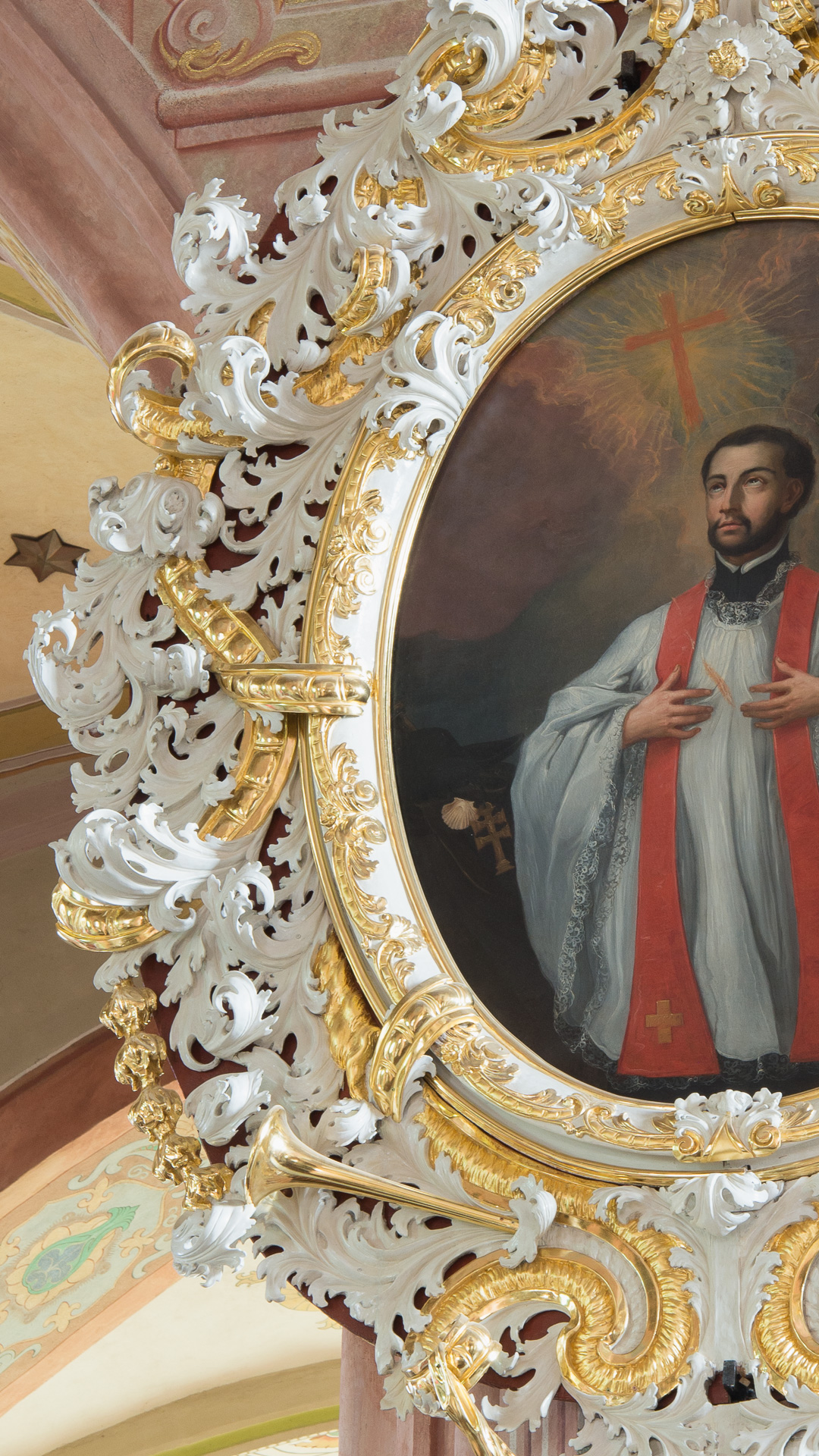


Description: The oval image contains a depiction of St. Francis Xavier in religious and priestly clothes, surrounded by attributes. The saint is shown in a standing (or kneeling) position – wide robes make it difficult to determine the pose), 3/4 of the figure’s height. Francis is depicted almost frontally, with his head very slightly turned to the right (heraldic) side and slightly raised. A face with portrait features, of a rather Mediterranean type, with a wide forehead and a prominent straight nose, with large ears (left visible), with slightly parted lips, framed by very dark: short stubble and also short hair; dark eyes lifted upwards, slightly pink complexion. Both hands of the saint are bent at the elbows, the fingers touch the breasts – between them, you can see flames coming out of the body. Ksawery was dressed in a habit with a white collar of his lower robe visible at the neck and in a grey-white surplice, richly folded, with very wide sleeves, trimmed with lace at the edges. A red stole is thrown over the neck, falling from the front ends to the very bottom of the figure (light brown crosses at the ends). On the left side of the picture, at the right elbow of the saint, his attributes are visible. This part of the composition is mostly in very dark, grey-green tones, against which two objects stand out – yellowish and grey-white: a cross with two horizontal arms (similar to a carawaki) and a pilgrim’s shell; a pilgrims hat visible above. On the right side of the composition field, at the top, there are elements of monumental architecture: a gray-brown column on a pedestal partly covered with tangled dark green drapery. On the opposite side, at the top, against the background of the sky covered with gray-pink clouds, illuminated in the central part by the glory of yellow rays, a simple red cross is depicted. Partially openwork frame. In the general outline of an oval, slightly elongated on the vertical axis (slightly more from the top, where it has the character of a finial, at the top of which a large volute is placed); from the bottom, a frame with suspended festoons tied in the form of a bow on the axis. Constructed of symmetrical, multi-layer weaves of acanthus flagellum in the white color of the polished ground, with a sharp styling (but not withering yet) and gold motifs: profiled slats, sections of a wrinkled ribbon, usually twisted, and ribbons with the motif of cabochons and rows of campanulas. In the lower part, the composition is complemented by two horizontally arranged trumpets directed in opposite directions.
Provenance: The painting belongs to a series of nine compositions funded by the Świdnica Jesuits as part of the baroqueization of the Gothic interior of the church in Świdnica, which lasted several decades. The paintings were commissioned in 1700 by two Silesian painters: four from Knechtl and five from Johann Jacob Eybelwieser the Younger. Knechtel probably painted his paintings quite quickly, already around 1700, while Eybelwieser – judging from the signatures and dates discovered during the conservation works on some of his paintings from the series (including the painting of St. Francis Xavier discussed here) – completed his part of the commission in 1710, and probably then rich frames for all the canvases were made.
Characteristics: The painting belongs to a series that was intended to illustrate the merits of the Jesuits in the history of the Catholic Church by showing the most outstanding representatives of the order. Next to St. Ignatius of Loyola (whose performance was also included in this series), the greatest fame among the first Jesuits was gained by St. Franciszek Ksawery, a nobleman born in 1506 in the Basque country, in a family attached to French culture. Destined from his youth to the priesthood, he studied in France and, having met Ignatius Loyola, became his faithful companion. From the very beginning, after joining the Jesuits, he wanted to carry out missionary activity, and in 1541 he left Portugal for East Asia, where for ten years he converted people from many lands (earning him the nickname of the Apostle of India) and even reached Japan. Unsuccessfully wishing to enter mainland China, he died in 1552. He rests in Goa, India, was canonized in 1622, and since 1927 he has been the patron of Catholic missions. The painting from Świdnica, with the use of attributes (a cross, a shell, a pilgrim’s hat), discreetly emphasizes his missionary expeditions and zeal for faith (which is illustrated by the flames coming out of his chest). The part of the series, to which the picture in question belongs, was entrusted by the monks from Świdnica to the Wrocław guild painter, Johann Jacob Eybelwieser. These are some of his earliest works. Some of them, resembling portraits to some extent, are characterized by a dynamic shot, painted with great care and subtlety. A painting depicting St. Francis Xavier, as well as the image of St. Ignatius of Loyola, as mentioned above, also present in this series (which was the reason for confusing the two paintings with each other), is characterized by a suggestive and active depiction of the figure that imposes itself on the viewer with great force. Both paintings perfectly illustrate the heroism of faith and universalism of the first generation of Jesuits.
The painting was formerly a painting mistakenly believed to be a depiction of St. Ignatius of Loyola. Attributes of St. Francis Xavier: objects and symbols referring to his missionary activity, and above all the flames coming out of his chest, are widely known and refer to the famous missionary, one of the most outstanding and well-known representatives of the Jesuit order. The cycle from Świdnica also includes a performance of St. Ignatius Loyola with a slightly similar type of physiognomy (remember that both came from the Basque country) but with completely different attributes. However, St. Francis Xavier, like St. Ignatius of Loyola, was depicted in a habit, surplice, and with a stole, although in a different pose. Presumably, it was the similar outfit that caused the two characters to be confused.
Bibliografia
Edmund Nawrocki, Kościół parafialny św. Stanisława i św. Wacława w Świdnicy. Przewodnik, Świdnica 1990, s. 23.
Henryk Fros SJ, Święci i błogosławieni Towarzystwa Jezusowego, Kraków 1992, s. 21-24 [tylko do ikonografii – nie zawiera wzmianki o obrazie ze Świdnicy].
Rainer Sachs, Teresa Sokół, Życie i twórczość rzeźbiarza Tobiasa Franza Stallmeyera (1673-1747), [w:] Dziedzictwo artystyczne Świdnicy, Pod redakcją Bogusława Czechowicza, [Książka zawiera materiały z sesji naukowej odbytej w Świdnicy w dniu 2 czerwca 2000 roku], Wrocław- Świdnica 2003, s. 150 i 152.
Dariusz Galewski, Jezuici wobec tradycji średniowiecznej. Barokizacje kościołów w Kłodzku, Świdnicy, Jeleniej Górze i Żaganiu, Kraków 2012 (Ars Vetus et Nova, Redaktor serii Wojciech Bałus, T. XXXVI), przypis 28 na s. 222.
Barbara Skoczylas-Stadnik [tekst], Franciszek Grzywacz [fotografie], Katedra świdnicka perłą Dolnego Śląska, Legnica 2016, s. 43.
Malarstwo barokowe na Śląsku, pod redakcją Andrzeja Kozieła, Wrocław 2017, s. 386 (autorzy noty poświęconej malarzowi: Andrzej Kozieł i Marek Kwaśny).