Mother of God
The Author Johann Jacob Eybelwieser the Younger
Date of creation painting and frame 1710
Dimensions The painting - height 214 cm, width 173 cm Frame - height 494 cm, width 325 cm
Material / Technique canvas carpentry and woodcarving techniques colored primer gilding oil technique polished primer wood
Exposure location Main Nave southern wall over the first pillar of the inter-nave arcade going from the east


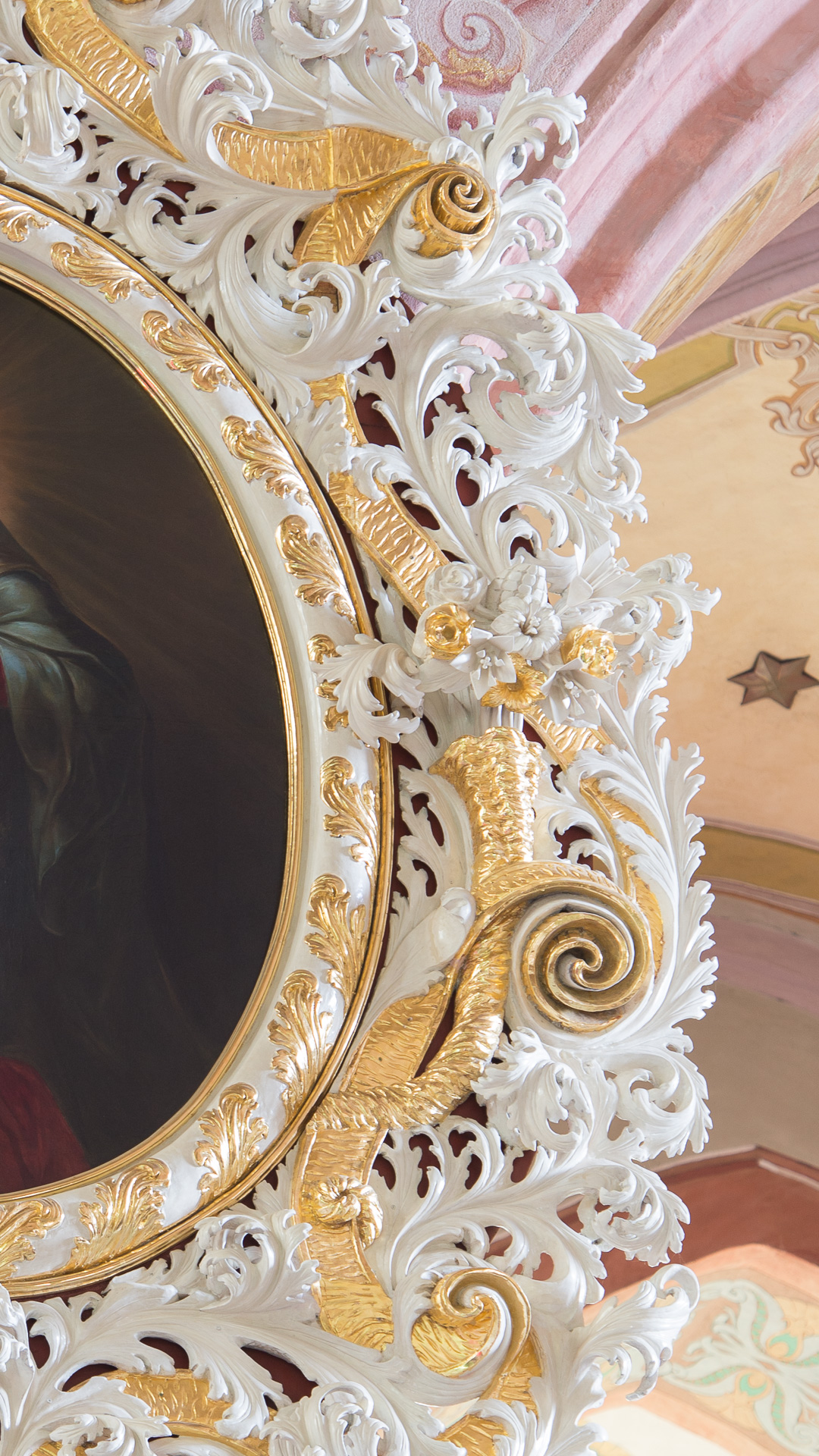


Description: The oval image contains the depiction of the Mother of God in a “portrait” approach, remaining outside the iconographic types, in the approach closest to Mary from the scene of the Annunciation. The figure against a dark brown background illuminated mainly around Maria’s head with regularly distributed rays. The standing Mother of God depicted more than 3/4 of the figure’s height, slightly turned to the right (heraldically) side. A face with delicate features, strongly elongated, with a long straight nose, with slightly closed eyelids and eyes looking downwards (dark eyes), with a pale, very slightly and evenly pink complexion, surrounded by long light brown hair, parted in the middle, falling down the sides of the face, partially visible from under the maphorion. Both hands of the figure are bent at the elbows, hands at the height of the breast: the Mother of God touches the body with her right hand with her fingers on the axis of the figure, near the heart, the left one is raised in a gesture of refusal, the back of her hand is directed towards the figure. Maria dressed in a long, dark pink robe tied at the waist with rolled fabric, with long, tapering sleeves, and a richly pleated coat with a calm arrangement thrown over her forearms; blue coat. Maria’s head is covered with a grey-brown, relatively light scarf (maforion); its ends cross over the chest on the right side of the figure. Partially openwork frame. In the general outline of an oval, slightly elongated on the vertical axis (slightly more from the top, where it has the character of a finial, on the axis of which, at the top, a horn with a bunch of lilies and roses), cut straight from the bottom. Made of symmetrical, multi-layered weaves of acanthus flagellum in the white color of the polished ground, with a sharp styling (but not yet withering) and white and gold flowers of lilies and roses. The described weaves are enriched with motifs wholly or partly gold: profiled strips, sections of a gathered ribbon, usually twisted (with volute endings), and horns serving as flower vases.
Provenance: The painting belongs to a series of nine compositions funded by the Świdnica Jesuits as part of the baroqueization of the Gothic interior of the church in Świdnica, which lasted several decades. The paintings were commissioned in 1700 by two Silesian painters: four from Knechtl and five from Johann Jacob Eybelwieser the Younger. Knechtel probably painted his paintings quite quickly, already around 1700, while Eybelwieser – judging from the signatures and dates discovered during the conservation works on some of his paintings from the series (including the painting of the Virgin Mary discussed here) – completed his part of the commission in 1710 and it was probably then that rich frames for all the canvases were made.
Characteristics: The painting belongs to a series that was intended to illustrate the merits of the Jesuits in the history of the Catholic Church by showing the most outstanding representatives of the order. However, the principals rightly considered it necessary to show the Jesuit saints in the context of the entire history of salvation. That is why the cycle begins with representations of Christ (as the Savior of the World) and the Mother of God, hung closest to the main altar of the church. Its representation is difficult to classify as an iconographic type. She rather resembles Mary from the scene of the Annunciation (the gesture of refusal is significant here), which means that the Mother of Jesus is shown as the Mother of God. The part of the series, to which the picture in question belongs, was entrusted by the monks from Świdnica to the Wrocław guild painter, Johann Jacob Eybelwieser. These are some of his earliest works. Some of them, resembling portraits to some extent, are characterized by a dynamic shot, painted with great care and subtlety.
Bibliografia
Edmund Nawrocki, Kościół parafialny św. Stanisława i św. Wacława w Świdnicy. Przewodnik, Świdnica 1990, s. 23.
Rainer Sachs, Teresa Sokół, Życie i twórczość rzeźbiarza Tobiasa Franza Stallmeyera (1673-1747), [w:] Dziedzictwo artystyczne Świdnicy, Pod redakcją Bogusława Czechowicza, [Książka zawiera materiały z sesji naukowej odbytej w Świdnicy w dniu 2 czerwca 2000 roku], Wrocław- Świdnica 2003, s. 150 i 152.
Dariusz Galewski, Jezuici wobec tradycji średniowiecznej. Barokizacje kościołów w Kłodzku, Świdnicy, Jeleniej Górze i Żaganiu, Kraków 2012 (Ars Vetus et Nova, Redaktor serii Wojciech Bałus, T. XXXVI), przypis 28 na s. 222.
Barbara Skoczylas-Stadnik [tekst], Franciszek Grzywacz [fotografie], Katedra świdnicka perłą Dolnego Śląska, Legnica 2016, s. 42.
Malarstwo barokowe na Śląsku, pod redakcją Andrzeja Kozieła, Wrocław 2017, s. 386 (autorzy noty poświęconej malarzowi: Andrzej Kozieł i Marek Kwaśny).