Apotheosis of St. Wenceslaus
The Author Johann Georg Etgens
Date of creation 1739
Dimensions height 11.1 m, width 4.78 m
Material / Technique fresco finished al secco with the lime casein technique
Exposure location Chancel southern wall the second span going from the east

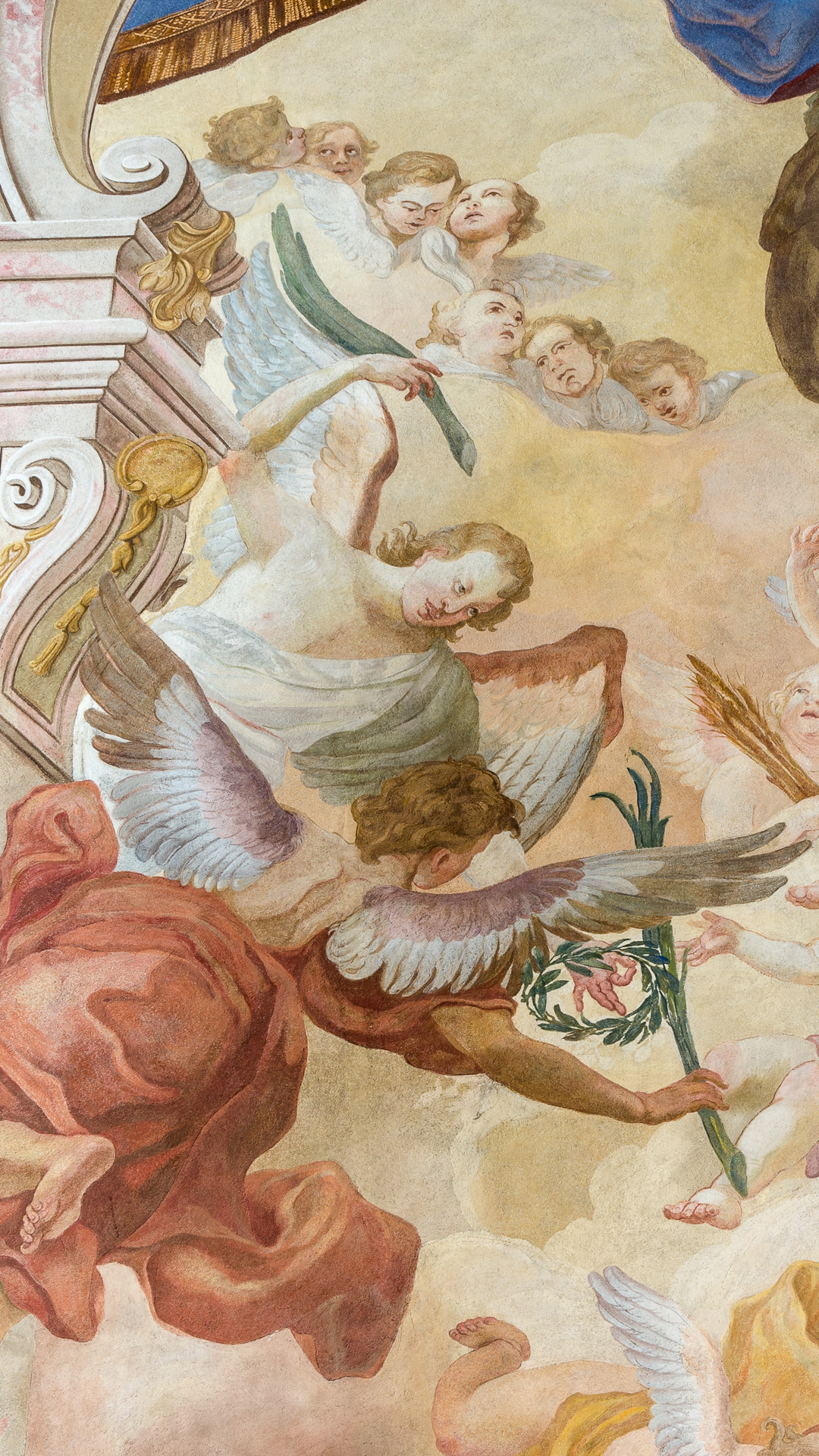


Description: The composition fills the upper part of the surface of the side wall of the span, closed from the top with a pointed arch (hereinafter this surface is also referred to as the field). Almost all architectural and ornamental elements used to decorate the bay and to separate it from the adjacent bays (the chancel from the east and the central nave from the west) are painted in an illusionistic way (the few that exist are especially emphasized at the beginning of the description). In the upper part, the flat surface of the wall meets the triangular in projection, spherically bent upwards, gently pointed vault (called kozuba – here referred to as the “lunette”). The walls of the lunette and their painting decoration (due to the coats of arms found there) are partly included in the description of the field, at its end. The walls of the lunette from the outside are framed with ribs dividing the vault visible above into smaller fields. The ribs flow down to short, wide, flat bands supported from the bottom by consoles, which protrude less and less from the wall as they go down, and finally blend into it. The above-mentioned architectural elements are the only ones with which the described side wall area is in contact. Their continuation is the illusionistic painting decoration described below. Paintings of the field of the bay wall in its upper part, visible above the pseudo-altar with a large painting of the Martyrdom of St. Wenceslaus, is covered with painted architectural, ornamental, and figural decorations (in the further part of the description, this decoration is treated as a collection of actually existing artistic motifs, sometimes without indicating that these are illusionistic representations, rendered in a layer of paint on a flat surface of plaster). The area of the side wall of the bay is primarily filled with architectural motifs separating this area from the surface of the next eastern bay of the chancel and the west of the first bay of the nave. Architectural motifs also organize the surface of the top part of the wall, which is in contact with the lunette and is bounded by a pointed arch. Elements of the vertical divisions of the main field below seem to “emerge” from behind the pseudo-altar set below this wall. The wall surface is filled with a window at the bottom of the group described below, glazed with hexagonal tiles framed in a narrow strip, entirely adopting the “honeycomb” pattern. These tiles respect the vertically running four profiled sticks dividing the window surface into five parts. In addition, within the glazing, there are expressive horizontal strips separating the quarters and additional horizontal and vertical divisions of the quarters. Abov the glazing covering about 1/4 of the window’s height, there is a complex figural composition with an irregular outline (description below). In its upper part, a large opening is visible, within which you can see a smooth sky and not a continuation of the window glazing. The frame of this window is rich, composed of many architectural elements, more like a portal than a window frame, with all components fully visible only from the left side of the window. From this side, by showing the glyph of the window (set at right angles to the glazed surface), a rather significant thickness of the wall is marked in a perspective foreshortening. The window on the sides is framed by massive, rectangular pillars embedded in the wall, and further by pilasters set at right angles to the pillars, already embedded on the front surface of the church wall. Pilasters and pillars on the surfaces facing the viewer, decorated with different panels – those on the surface of the pillars are decorated at the very top with types of strongly stylized “bows” made of leaves and volute forms, from which sections of flagella hang down. At the top of the side surface of the pillars (visible in the thickness of the wall) and the front surface of the pilasters, there are massive heads in the form of volute consoles. On the pillars, smaller capitals are supplemented from above with smooth cartouches and strings of flagella flowing downwards. On the pilasters, capitals larger than those previously described are decorated with: rows of overlapping sequins, winged heads of angels, and massive garlands. The consoles on the pillars and pilasters support the step-shaped cornice, broken at their contact. Above the pillars, there are stepped profiled imposts on which a horseshoe arch is supported, closing the arcade containing the window from above. The arch is framed by a wide, stepped band from the outside, finished with small volutes at the bottom. The arch from the bottom, on the surface of the wall thickness, is decorated with symmetrically arranged panels, volutes, a rosette (on the axis, at the top of the arch), and coils of a ribbon ornament similar to the arrangement of the Regency ribbon. The area in the depths of the arcade, above the described glazing of the window, is filled from the level of about 1/4 of the height of the visible part of the arcade (going from the bottom) with a composition containing billowing clouds surrounding the empty surface of the sky with smoothly shaped clouds above. The clouds are complemented by a tangled curtain visible at the top and on the right side of the arcade, finished with fringes at the bottom edge. Angels (including three in the form of adults) and angel heads are visible against the background of clouds, sky, and curtains. Angels in extremely lively, complicated poses, wrapped in draperies, hold attributes of the dignity of St. Wenceslaus (prince’s miter and scepter?) and grapes, ears of corn, palm leaves, and a laurel wreath. The wall decoration elements described so far are kept in slightly subdued, pastel colors. Walls and their decoration: white, greenish, and yellowish-brown, windows in the window pale blue. The clouds and the sky are white, sometimes in shades of pink and lilac, blue drapery, brown tassels, and draperies shrouding angels in white, green, and dark pink. Gray surfaces (in shades) and green accents are also visible. In the upper part of the horseshoe arch closing the arcade from above, its frame is overlapped on the sides by loosely hanging sections of a garland (mainly composed of fruit) connecting at the top with a rich cartouche filling the end of the wall surface, limited at the top by a pointed arch. The cartouche is generally round and made of volute and floral motifs. On the axis of the cartouche hangs a single motif with a campanula visible against the background of the frame of the horseshoe arch. The brown cartouche is on a grayish background. In the center of the cartouche, there is a circular field filled with the emblem of the Roman Empire of the German Nation, depicting a two-headed black eagle depicted on a brown background (heraldically correct gold) and with an open imperial crown (heraldically gold, here brown in shades) placed on the axis above. On the eagle’s chest, there is a two-part shield with emblems: on the right heraldic side of the Habsburgs (three horizontal stripes: middle white, lower and upper red), on the left of Castile (the tower on a red field, from the bottom preceded by a white field with a height of 1/3 of the height of the emblem; the tower should be golden, here it is beige). Around the shield, a white inscription on a gray-blue background: “+CAROLUS V. ROM: IMP. S. A. BARBARIAM EXPUGNAT. 1535” (“Charles V, Holy Roman Emperor, defeated the barbarians in 1535”). The side surfaces of the lunette touching the upper end of the field are decorated with motifs made of tape, flagella, and campanula in the arrangement typical of the Regency ornament (white and gray motifs on a gray background). At the very bottom of the side fields of the telescope, there are shields, e.g. repeating colors of the emblems in the shield on the eagle’s chest – divisions of the shield into a diagonal cross on the left, diagonal stripes on the right; colors used here: white, red and blue.
History: The painting decoration of the presbytery and the main nave of the cathedral in Świdnica was commissioned by the Jesuits in 1739 to the outstanding Moravian painter Johann Georg Etgens. The then rector of the church, Karl Scholtz, came up with the initiative for this commission. According to the contract signed by the artist, work on painting the walls of the church lasted for a year. The execution of the paintings ended the long-lasting process of decorating the Gothic temple with rich Baroque carving, painting, and sculptural decorations.
Characteristics: The decoration of the upper part of one of the wall fields in the presbytery of the cathedral described here includes only a small fragment of a very rich work by Etgens, visible inside the presbytery and nave. A large part of these paintings has its well-thought-out iconographic program, sometimes independent of the neighboring fragments, but usually constituting a component of a larger part of the decorations. In the presbytery, on the side walls of the western bay, directly adjacent to the central nave, there are paintings in their upper parts that are particularly important, because they refer to the patrons of the temple: on the southern wall – described here – St. Wenceslaus, the Czech prince, and on the northern wall, opposite – St. Stanislaus, Bishop of Cracow. This is since at the bottom, by these walls, there are rich carved frames with forms very similar to altars (they were made in the years 1690-1694). In these pseudo-altars, large easel paintings on canvas depicting the martyrdom of both patrons of the temple were placed. Thus, below the described painting decoration, you can see the painting Martyrdom of St. Wenceslaus, the work of the most outstanding Silesian Baroque painter, Michael Willmann (1630-1706), made in 1668. Originally, it was probably a painting decorating the earlier than the present main altar of the temple, commissioned by the Jesuits. Due to such proximity, the theme of the representations depicted above on the church wall, emphasizing the admission to heaven of St. Wenceslaus after his martyrdom for the faith seems completely understandable. The fact that some angels hold ears of grain and grapes in their hands, symbolizing the Eucharist, is obvious in the vicinity of the main altar (especially since they are also attributes of the Saint). What seems puzzling, however, is the sense of placing a circular shield at the top of the wall with the imperial coat of arms, with the personal coat of arms of Charles Habsburg (1550-1558), king of Spain and also emperor (as Charles V) in the years 1519-1556 on the chest. The inscription in a circular rim around the shield also refers to him, indicating his great victory over the Turks near Tunis in North Africa in 1535. His person and this event had no connection with the realities of the times in which Etgens made the paintings. It should therefore be assumed that the artist repeated the coats of arms found here earlier. Indeed, Charles V never ruled directly over the Duchy of Świdnica (he was not the king of Bohemia, to whom it was subordinated), but in the times when he was the emperor ruling over all German lands, there was a tragic event, which was the fire of the church in 1532, and its reconstruction, completed in 1535. This explains sufficiently why the coat of arms of Emperor Charles V was painted on the chancel wall of the temple and his greatest victory over the infidels was mentioned, which he achieved exactly when the reconstruction of the destroyed church was being completed.
Bibliografia
Hans Lutsch, Verzeichnis der Kunstdenkmäler der Provinz Schlesien, Die Kunstdenkmäler der Landkreise des Reg.-Bezirks Breslau, Breslau 1889, s. 307.
Hermann Hoffmann, Die Jesuiten in Schweidnitz, Schweidnitz 1930 (Zur Schlesischen Kirchengeschichte, Nr 3), s. 154, 311.
Ignacy Płazak, Działalność artystyczna morawskich malarzy-dekoratorów na Śląsku w XVIII wieku, „Biuletyn Historii Sztuki” XXVII, 1965, Nr 4, s. 307.
Danuta Hanulanka, Świdnica, Wydanie II poprawione i uzupełnione, [seria: „Śląsk w Zabytkach Sztuki”, pod redakcją T. Broniewskiego i M. Zlata], Wrocław-Warszawa-Kraków-Gdańsk 1973, s. 92-93.
Adam Organisty, Joseph Langer (1865-1918). Życie i twórczość wrocławskiego artysty, [seria: „Ars Vetus et Nova”, Redaktor serii W. Bałus, T. XXII], Kraków 2006, s. 164.
Dariusz Galewski, Kościół Jezuitów w Świdnicy na tle pozostałych gotyckich świątyń prowincji czeskiej Towarzystwa Jezusowego [w:] Śląsk i Czechy. Wspólne drogi sztuki, Materiały konferencji naukowej dedykowane Profesorowi Janowi Wrabecowi, [seria: „Acta Universitatis Wratislaviensis” No 2953, „Historia Sztuki” XXIV], Wrocław 2007, s. 257.
Sobiesław Nowotny, Przewodnik po świdnickiej katedrze, Autor zdjęć Mariusz Barcicki, Świdnica 2009, s. 67.
Dariusz Galewski, Jezuici wobec tradycji średniowiecznej. Barokizacje kościołów w Kłodzku, Świdnicy, Jeleniej Górze i Żaganiu, [seria: „Ars Vetus et Nova”, Redaktor serii W. Bałus, T. XXXVI], Kraków 2012, s. 126-127, 145, 220.
Barbara Skoczylas-Stadnik [tekst], Franciszek Grzywacz [fotografie], Katedra świdnicka perłą Dolnego Śląska, Legnica 2016, s. 24, il. górna prawa (Apoteoza św. Wacława; il. lewa – Apoteoza św. Stanisława), s. 32.
Malarstwo barokowe na Śląsku, pod redakcją Andrzeja Kozieła, Wrocław 2017, s. 379-381 (autor noty poświęconej malarzowi: Adam Szeląg).
Sobiesław Nowotny, Przedstawienia heraldyczne w prezbiterium świdnickiej katedry, Świdnica 2022, opracowanie historyczne w Archiwum Firmy Konserwatorskiej Piotr Białko w Krakowie [wydruk].