St. Stanislaus casting a curse on King Bolesław the Bold
The Author Jeremias Joseph Knechtel
Date of creation years 1710-1720
Dimensions height 590 cm, width 430 cm
Material / Technique canvas colored primer oil technique
Exposure location Main Nave northern wall over the third inter-nave arcade going from the east

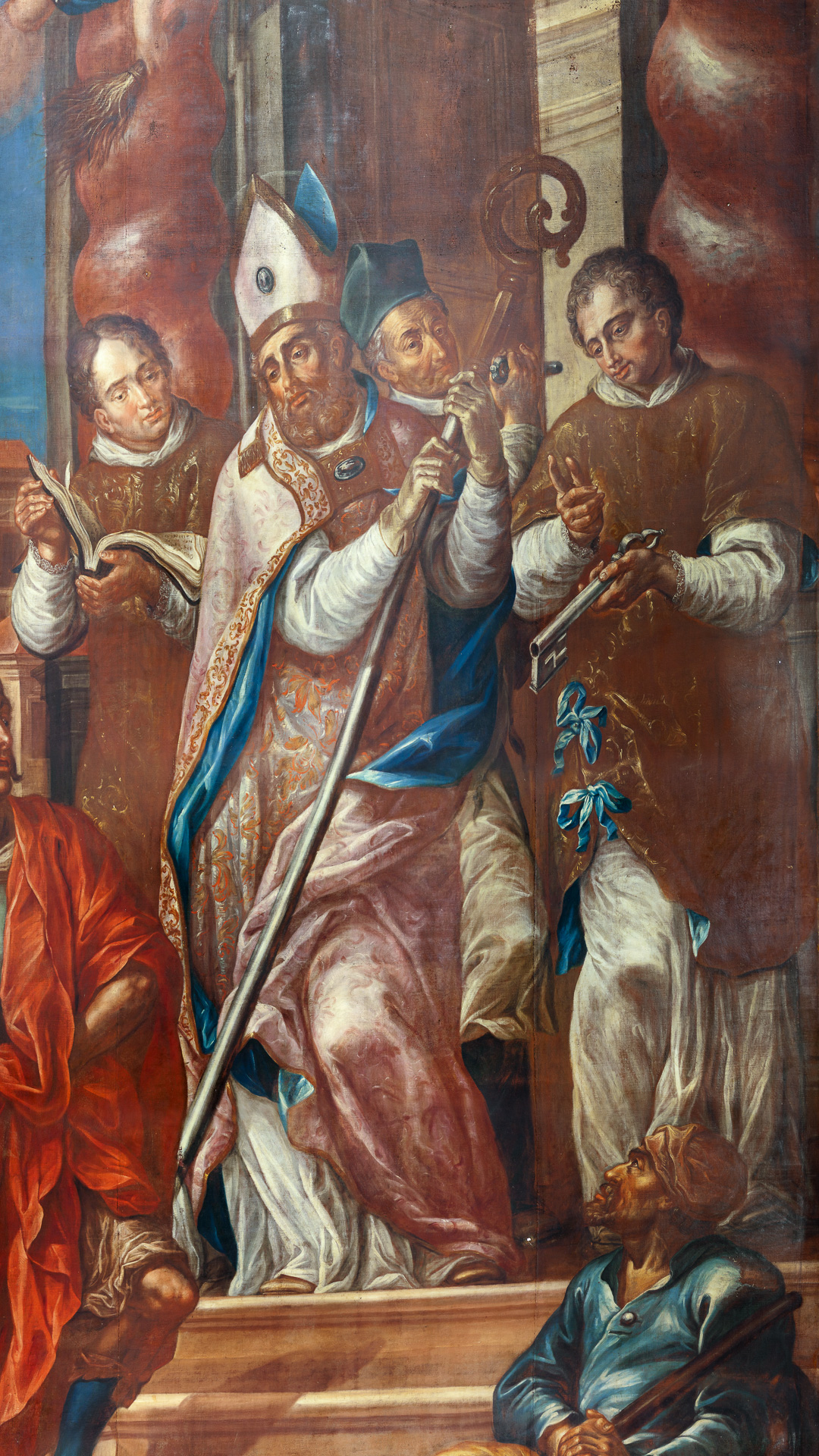


Description: A picture painted on a canvas in the form of a vertically positioned rectangle. The composition depicts St. Stanislaus, the bishop of Cracow who cursed King Boleslaw the Bold. A multi-figure scene with a crowd of figures and a complex composition. The whole thing takes place against the background of brown (in shades) and gray architecture – in front of the entrance to the church; to the left of the viewer) at the top, slightly to the right (heraldically) of the image axis, there is a clearing with the sky and clouds. At the bottom of the foreground, brown earth is depicted. On the right side of the composition field (from the viewer) there is an entrance to the church, situated on a raised platform, preceded by three steps. The rectangular portal, the door ajar, behind them can be seen the interior of the temple with architectural elements. The portal is flanked by two curly columns, the upper part of the façade is obscured by clouds and cut off by the edge of the painting. On the platform in front of the entrance to the church, you can see a group consisting of St. Stanislaus and the three clergy surrounding him visible from the sides and the back. The saint is shown in the full body in animated movement; he is turned in 3/4 towards the axis of the painting, his silhouette is twisted in the form of the letter “S”, and the hips are slightly extended to the right (heraldic) side. The saint’s head is tilted slightly downwards, the face with the features of an older man framed by stubble with a medium-length beard; stubble, and visible hair fragments brown. Stanislaus, with his hands, raised upwards, visible on the left (heraldically) side, at the height of the neck, holds the upper part of the crosier set diagonally, and is dressed in a bishop’s outfit (a white alb, a chasuble with a brown fabric pattern and a blue cover from the bottom, pink and purple top, fastened a clasp with a jewel under the neck; a hem of a white amice visible at the neck, and a white miter on the head, blue underneath, with a jewel on the axis); robes of a saint with summarily treated folds full of movement. Clergymen standing next to the saint in full form (one partly visible at the back), in a very lively movement, holding various objects in their hands (deacons on the sides hold: left – from the viewer – an open book, which the saint is probably looking at, right – a key; the second key is held by a priest standing behind the saint). Two deacons on the sides wear white albs, amices, and red-brown dalmatics under their necks (in the case of one of them, closest to the right edge of the painting – from the viewer – blue ribbons can be seen from one of the sides of the dalmatic). The clergyman standing behind the saint is wearing a poorly visible canon’s outfit and a black biretta on his head. A counterbalance to the group from St. Stanislaus is a group of soldiers accompanying the king, occupying the left (from the viewer) half of the painting. The most important figure here is the monarch, standing close to the saint, at the foot of the stairs, depicted in full form, facing the viewer, but with his head turned 3/4 to the left (heraldic) side. His face, with a very expressive, even brutal expression, with a “bushy” mustache is similar to the Sarmatian type known, among others, from from the portraits of John III Sobieski and his contemporaries, although it is of course significantly “exaggerated”); the character’s hair and stubble are brown. The ruler puts his left foot on the first step of the stairs, and his hand on the same side is supported by his side. He holds a bronze scepter in his downturned right hand. He is dressed in an undergarment, antique gray-blue half-armor (or a torso cover made of soft material, e.g. dyed leather, covering the body), a red coat with monumentalized folds, and blue shoes covering the calves. The soldiers accompanying him, standing in animated poses in a group behind him, are facing the king, although their heads are turned in different directions. One of them, with his back to the viewer, is shown in the foreground, closest to the viewer, looking at this group. Soldiers hold polearms visible above their heads. They are dressed in mostly timeless clothes, with small elements referring to oriental fashion (e.g. a fur hat on the head of the soldier shown closest to the king); colors are visible here. white, green, and pink, and shades of brown and gray. In the right (viewer’s side) corner of the painting, a beggar in tattered clothes (brown trousers, a blue caftan, and a brown cap) sitting on a stone, looking at the king, with a stick. The equivalent of this figure in the second lower corner is a stone lying on the ground, against which the foot of the soldier shown from behind is leaning the closest to the viewer. In the far background, in the background of the main stage, brown buildings are depicted at the bottom, above which you can see a blue sky with white clouds. At the upper edge, in the nearer plane of the painting, white-gray and pink clouds are visible, and against their background, there are figures of three flying angels covered with colorful draperies. One of them, closest to the left (from the viewer) edge of the picture, is holding a broken candle, the others going to the left (heraldic way): the middle one has a red and the last one holds a rod in his left hand and a flaming sword in his right hand.
History: The painting belongs to the series placed on the walls of the nave dedicated to two saint patrons of the church (and at the same time the patrons of the countries they came from): Stanislaus, the bishop of Cracow, and a martyr, and Wenceslaus, the Czech prince and also a martyr. The entire series was created on the initiative of the Jesuits, but only this one painting and its frame were financed by the college in Świdnica. Perhaps the Jesuits commissioned the painting at their own expense to set an example for potential sponsors. If this was the case, it can be assumed that the painting was created quite early, maybe even before the foundation of Johann Anton von Schaffgotsch in 1711 (the painting of St. Stanislaus distributes alms). However, this is only a hypothesis.
Characteristics: The decision to make large paintings illustrating the lives of its patrons for the church in Świdnica was obvious due to the lively liturgical cult of the saints mentioned in this church. Popularity in Silesia in the Middle Ages of the patron saint of Poland, St. Stanislaus was large and to some extent survived until modern times. Hence the good knowledge of the saint’s life and the accuracy in rendering the iconographic theme. On the other hand, the individual predispositions of the painter, Jeremias Joseph Knechtl, who willingly used exaggerations and excessive expression in his works, perfectly matched most of the dramatic episodes from the life of St. Stanislaus.
Bibliografia
Hermann Hoffmann, Die katholische Pfarrkirche in Schweidnitz, Schweidnitz 1930, s. 12-13.
Danuta Hanulanka, Świdnica, Wydanie II poprawione i uzupełnione, [seria: „Śląsk w Zabytkach Sztuki”, pod redakcją T. Broniewskiego i M. Zlata], Wrocław-Warszawa-Kraków-Gdańsk 1973, s. 93
Edmund Nawrocki, Kościół parafialny św. Stanisława i św. Wacława w Świdnicy. Przewodnik, Świdnica 1990, s. 23
Dariusz Galewski, Kościół Jezuitów w Świdnicy na tle pozostałych gotyckich świątyń prowincji czeskiej Towarzystwa Jezusowego [w:] Śląsk i Czechy. Wspólne drogi sztuki, Materiały konferencji naukowej dedykowane Profesorowi Janowi Wrabecowi, [seria: „Acta Universitatis Wratislaviensis” No 2953, „Historia Sztuki” XXIV], Wrocław 2007, s. 257 i przypis 29.
Sobiesław Nowotny, Przewodnik po świdnickiej katedrze, Autor zdjęć Mariusz Barcicki, Świdnica 2009, s. 67 i 70.
Dariusz Galewski, Jezuici wobec tradycji średniowiecznej. Barokizacje kościołów w Kłodzku, Świdnicy, Jeleniej Górze i Żaganiu, [seria: „Ars Vetus et Nova”, Redaktor serii W. Bałus, T. XXXVI], Kraków 2012, s. 194 i 222 oraz tamże przypisy 29 i 30.
Jeremias Joseph Knechtel (1679-1750). Legnicki malarz doby baroku, Pod redakcją Andrzeja Kozieła i Emilii Kłody, [katalog wystawy], Muzeum Miedzi w Legnicy, Akademia Rycerska, październik 2012 – kwiecień 2013, Legnica 2012, poz. kat. A.97 na s. 194, il. na s. 195 (il. dolna lewa); tekst ogólny omawiający oba cykle – s. 194-198, kompletne zestawienie literatury do obrazów z obu cykli – s. 194 – teksty opr. Emilia Kłoda.
Barbara Skoczylas-Stadnik [tekst], Franciszek Grzywacz [fotografie], Katedra świdnicka perłą Dolnego Śląska, Legnica 2016, s. 36, il. prawa na s. 36.
Malarstwo barokowe na Śląsku, pod redakcją Andrzeja Kozieła, Wrocław 2017, s. 488 (autorka noty poświęconej malarzowi Jeremiasowi Josephowi Knechtelowi: Emilia Kłoda).
Sobiesław Nowotny, Herby na ramach wielkich obrazów w nawie głównej świdnickiej katedry, Świdnica 2021, opracowanie historyczne w Archiwum Firmy Konserwatorskiej Piotr Białko w Krakowie [wydruk].