St. Stanislaus distributes alms
The Author Tobias Franz Stallmeyer
Date of creation 1711
Dimensions height 937 cm, width 741 cm
Material / Technique carpentry and woodcarving techniques gilding and polychrome polished primer wood
Exposure location Main Nave northern wall over the fifth inter-nave arcade going from the east

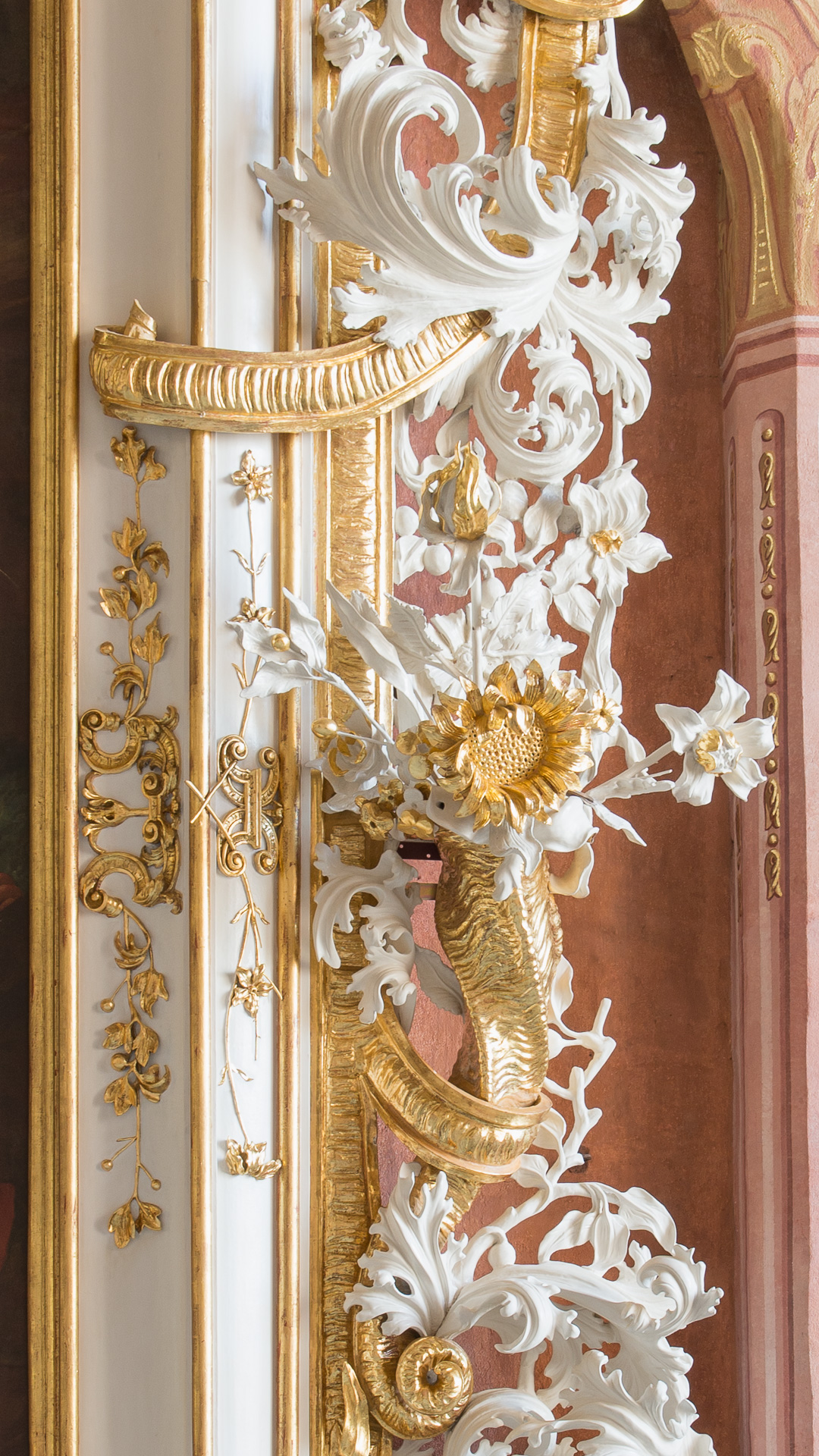


The frame of the picture, in the shape of a vertical rectangle, in its main part is made of relatively wide slats, profiled in such a way that they create the illusion of a greater than the actual depth of the frame. Outside and inside the main part of the frame and in the middle, between the white slats, there are three narrow, profiled gold slats (the slat closest to the image field is slightly wider). The slats they cover, in the white color of the polished primer, are the inner wider than the outer and concave, while the other, narrower, very slightly convex, is set straight towards the viewer. On both of these slats, there are ornamental motifs placed within the width of the slats, flat, golden, made of wavy thin twigs with leaves and a few flowers; floral patterns are complemented by scrolls of slightly varied ornaments made of ribbon sections with volute endings. The described motifs occur near the corners and in the middle of the side and top sections of the frame. At the mentioned three sides of the frame, plastic, openwork “ears” are placed outside it – scrolls of acanthus leaves with a slightly dry stylization, a few twigs with circular fruits and lily flowers in the white color of the polished ground, intertwined with sections of a rather narrow, golden, cross-grooved ribbon with ends wrapped in a volute; gold single flowers, saber-shaped leaves, and single rosettes are also seen. In 2/3 of the height of the side edges of the main part of the frame, slightly wavy sections of a golden, grooved ribbon overlap it. The side “ears” at the bottom have spatially shaped, openwork, spirally wrapped sections of the ribbon supplemented with strings of cartilage. The scroll of the ornament at the upper edge is symmetrically shaped, slightly raised on the axis. The “ears” at all three edges have a different width and widen on the axes. At the bottom edge of the frame, on the sides, there are two partially openwork garlands in white and gold colors, the outer ends of which are attached to the lower ends of the coils (“ears”) at the side edges of the frame. Almost symmetrical garlands, made of various leaves, rosettes, and twigs with flower calyxes, e.g. bell-shaped. The inner ends of the garlands are attached to a symmetrical cartouche placed in the middle of the lower part of the frame, partly openwork. The top of the cartouche extends onto the field of the picture, and the bottom reaches below the line of the garlands, sticking out strongly from the surface of the frame. Its structure is very complicated, composed of many heraldic motifs and purely ornamental elements combined with them. The cartouche is wide, stretched horizontally, and generally oval, but with a very irregular edge, determined by the course of the outer line of ornaments decorating the cartouche and parts of the coats of arms themselves. On the axis of the cartouche, there is a large, rectangular coat of arms, closed at the bottom in the “donkey’s back”, above which there are three coats of arms of almost equal height. The shield is surrounded by the chain of the Order of the Golden Fleece. On the sides of the main shield, there are two much smaller shields closed at the bottom with arches: very slightly sharpened (heraldic right shield) and trefoil (left). These shields are set low, topped with jewels proportionally smaller than the three previously mentioned. All three shields are surrounded by symmetrically arranged coils of acanthus flagellum, some of which are labras flanking the coats of arms; coils of flagella are supplemented with ribbons decorated with a kind of cartilage, with volute, even spirally twisted ends. The main cartouche at the very bottom is accentuated with a flat white acanthus leaf curled at the end. In the lower part of the cartouche, above the leaf and below the line marked by the lower edges of the three shields, some elements complement the content and decorative program of the cartouche. Between the aforementioned acanthus leaf and the bottom of the central shield, there is a cartouche in the form of a horizontally extended rectangle with semicircular endings on the horizontal axis, with a blue field, in a gold frame, among others made of a notched roller and a ribbon decorated with a kind of “cartilage”, spirally wound on the axis of the cartouche. Below the described cartouche there is a ribbon, golden, slightly wavy, in the central part imposed on the aforementioned white acanthus leaf and a little further intertwined by two volutes on the sides, which are part of the entire ornamental decoration of this part of the frame. Further, it rises upwards and at the ends is attached to the twisted sections of the ribbon constituting an element of the decoration of the entire main cartouche. The wavy ribbon is optically divided into three sections corresponding to the coats of arms located above. The three shields are filled with emblems. The middle one contains the coat of arms of the von Schaffgotsch family in the form in force since 1708, when it was made dignified by Emperor Joseph I. The main shield of the coat of arms is divided into four fields. In the upper right (heraldic) and lower left (heraldic), there is a repeated emblem in the form of a black eagle of the Silesian dukes depicted on a golden field with a golden crown, with a golden, almost semicircular band on its chest, connected to a stylized, club-shaped cross. In the upper left (heraldic) and lower right (heraldic) fields there is a repeated emblem in the form of a white and red checkerboard referring to the Duchy of Legnica. The shield has a heart field, also quadruple, topped with a prince’s miter. In the upper right (heraldic) and lower left (heraldic) fields of this heart-shaped shield, there are vertical white and red stripes repeated in both fields, while in the upper left (heraldic) and lower right (heraldic) fields you can see the repeated emblem in the form of a golden-crowned griffin directed heraldically to the right, against a blue background, holding a stone in its claws. The individual elements of such a complex coat of arms mean: the coat of arms in the heart field – the coat of arms before 1708 referring to the von Schaffgotsch family, crowned with a miter by Emperor Joseph I, while the coat of arms in the main field is the coat of arms of the dukes of Legnica added in 1708 (which was related to the kinship of the aristocratic family with this royal family. In 1708, the emperor also slightly changed the three-piece jewel above the shield, which somehow complemented the complex emblem on the main shield with its symbolism, with each part of the jewel, cut in profile, containing a helmet at the bottom. In the right (heraldic) part, a plume (in blue and gold colors) rises from the helmet, against which at the bottom there is an oval field with the coat of arms of the Silesian dukes, the same as on the shield below. The central part of the jewel is decorated above the helmet with a representation of a flattened green knoll, on which stands a white sheep, heraldically facing the left with its head, with a band and a bell around its neck, standing under a conventionally depicted fir tree with a green crown. Above the helmet topped with a golden open crown, in the left (heraldic) part of the jewel, there is a griffin identical to that appearing in the von Schaffgotsch coat of arms in the heart field of the main shield. The entire main coat of arms is surrounded by acanthus leaf labras. Red on the right (heraldically) and blue on the left. The right (heraldically) of the smaller shields flanking the central shield contains the coat of arms of the von Sereni family with a jewel and silver and blue labras. The shield of this coat of arms is divided vertically into two parts. The right one (heraldically) shows a creeping crowned serpent, set vertically, bent three times, surrounded by curled leaves. In the left (heraldic) part, divided horizontally into three stripes, the following motifs are visible – going from the top: a winged horse jumping to the right (heraldic) side; below it, in the middle of the height of this part of the shield, there is a beam covered with vertically elongated rhombuses; at the bottom, the remaining part of the described vertical part of the shield, having a shape similar to a triangle with one side replaced by a shallow segmental arch, is surrounded at the edge with a thin gold band. In the jewel of this coat of arms, above the helmet surmounted by a golden crown, a winged horse is depicted facing the same direction as the horse visible on the main shield. In turn, the shield located on the left (heraldically) side of the von Schaffgotsch coat of arms contains the coat of arms of the von Kolowrath-Nowohradsky family, also with a jewel and silver and red labras. The shield of this coat of arms is filled with an emblem in the form of a silver and red double-headed eagle with a separate shield topped with a golden crown on the chest (the emblem of the Habsburgs and Austria on the shield: a white horizontal bar on a red background), partly obscured by an almost semi-circular golden band with three-leaf endings. In the jewel (simplified repetition of the emblem from the coat of arms) above the helmet with a golden crown, two eagle’s wings are depicted (silver emerging from behind the red one); on the first (from the viewer) red wing, on a golden band with trefoils placed vertically, there is a golden form of an inverted bell with a beam in the middle, topped with a crown. The whole of this extremely complex composition is complemented by inscriptions. On the oval shield on the axis of the composition, golden letters “J A G S” were painted at the bottom, while on the sash below red letters and the date were divided into three parts corresponding to the three parts of the band and at the same time three shields above: “M. F.S.G.S. | F. 1711 F. | A.T.S.G.K.”
History: An extremely richly decorated frame encloses a large painting belonging to the cycle placed on the walls of the nave dedicated to the two saint patrons of the church (and also the patrons of the countries they came from): Stanislaus, the bishop of Cracow and a martyr, and Wenceslaus, the Czech prince and also a martyr. A painting depicting one of the events in the life of St. Stanislaus: the saint distributing his property as alms for the poor. The entire series was created on the initiative of the Jesuits, except for one painting, others were funded by individuals and institutions (mainly the church) only sympathizing with the Świdnica college. The frame presented here is supplemented at the bottom with an exceptionally impressive cartouche. In it, the coat of arms of the founder, Johann Anton von Schaffgotsch, and the date “1711” are displayed in the main place. As can be seen, the frame and the painting are an example of a foundation made by a person outside the Jesuit religious circle. However, the particular importance of this monument results from the fact that the date of foundation of the work was placed on the frame of the painting – only once in the whole cycle. We can assume that it was the earliest (probably after the painting made by the Jesuits with their funds) work in the series and perhaps, as the foundation of one of the most powerful Silesian aristocrats, it was supposed to encourage other potential donors. Thanks to this date, we also know when the painting of the entire painting cycle began, which was probably completed around 1720.
Characteristics: The decision to make large paintings illustrating the lives of its patrons for the church in Świdnica was obvious due to the lively liturgical cult of the saints mentioned in this church. The Jesuits, unable to commission all the necessary works due to financial difficulties, funded – perhaps – only one painting. Among the others, two were commissioned by the clergy, while the others were financed by representatives of the Silesian aristocracy, but also by the townspeople of Świdnica. Johann Anton von Schaffgotsch (1675-1742) was undoubtedly the most powerful, richest, and most famous of the founders of the paintings from the discussed group. It is identified not only by the coat of arms described in detail above but also by the inscription in the horizontal cartouche below (all coats of arms and inscriptions as well as the persons they refer to were read, identified, and compiled by Sobiesław Nowotny, a researcher of the past of Świdnica). The inscription in question consists of the letters “J A G S”, which are an abbreviation of the founder’s name, surname, and title (“Johann Anton Graf von Schaffgotsch”, i.e. “Johann Anton Count von Schaffgotsch”). A slightly more complicated issue is the interpretation of the letter-and-date inscription on the ribbon below. It was sort of divided into three parts. The inscription in the middle, containing the date (“F. 1711 F.”) certainly refers to the foundation of the work, but we are not sure whether it applies only to Schaffgotsch, whose coat of arms is above (in which case it should be resolved as: “Fieri 1711 Fecit” i.e. “He ordered in 1711 to execute”), or whether the inscription also includes people whose coats of arms are on the sides (then it should be read as “Fieri 1711 Fecerunt” or “They ordered in 1711 to execute”). Regardless of which version is correct, the people whose coats of arms were placed on the sides of Schaffgotsch’s coat of arms were so important to him that he certainly wanted to include them in the spiritual benefits that were to flow from prayers for founders’ celebrated in every Catholic church. And these people were both his, coming from his wife’s aristocratic families, which can be identified by coats of arms and inscriptions on ribbons. On the left (from the viewer) part of the ribbon letters referring to the count’s first wife, Maria Franciszka, who died in 1707 (“M. F. S. G. S.” – “Maria Franziska von Schaffgotsch [geboren] Gräfin von Sereni” or “Maria Franziska von Schaffgotsch [born] Countess von Sereni”). On the right side of the ribbon, the letters refer to the second wife of the main founder of the painting and the frame, Anna Teresa – she was already his wife in 1711 when the painting and the frame were made (“A. T. S. G. K.” – “Anna Theresia von Schaffgotsch [geboren] Gräfin von Kolowrath” or “Anna Theresia von Schaffgotsch [born] Countess von Kolowrath”, it should be noted here that the correct, full surname of the family from which the second wife of Count von Schaffgotsch came was: Kolowrath-Nowohradsky, but a such shortening of the surname was allowed ). This is how this complex set of coats of arms and inscriptions should be read. The “presence” of both wives in this complicated rebus is probably justified not only by von Schaffgotsch’s respect or love for his lifemates but also by the desire to emphasize their excellent origin, which additionally graced the rank of their husband’s family. It is worth noting here that the second wife in particular contributed greatly to the survival and continuity of her husband’s family, as she bore him as many as fourteen children! Does the important question seem to be who was the founder of such an impressive work of painting framed in an even more sumptuous frame? Limiting ourselves to the basic information, it should be said that the von Schaffgotsch family has long been one of the most splendid in Silesia, and the basis for its position was huge land estates, e.g. covering the area of the Karkonosze Mountains with adjacent areas. After the Habsburgs suppressed Czech aspirations for independence in 1620 (Silesia was then part of the lands of the Czech Crown), the Schaffgotsch family lost a large part of their possessions and in 1634 was forced to abandon the Protestant religion and convert to catholicism. However, the Silesian aristocrats resigned themselves to the situation – for the next hundred years, they faithfully served the Habsburgs and the Catholic Church in Silesia. Count Johann Anton was particularly appreciated for this and in 1708 Emperor Joseph I confirmed the title of count used in this family, the family coat of arms was also made more dignified, which was noted above in the description of the extremely complicated emblem. The count was also honored with the extremely prestigious Order of the Golden Fleece. Already the father of the founder of the painting for the church in Świdnica performed important functions in the imperial administration in Silesia. It is worth saying about his son that for a very long time, in the years 1704-1740, he served as the starost of the Duchy of Świdnica-Jawor on behalf of the Czech emperors. He was also the last representative of the Habsburg administration in this area because shortly before his death (1742) Silesia was occupied by the Prussian army (1740-1741). Johann Anton von Schaffgotsch was not a particularly good administrator of his huge estates, he also spent too much on a lavish lifestyle – or rather on the ostentation of wealth so necessary in his sphere, also on the maintenance of his numerous offspring (including, among others, Philipp Gotthard, later Prince Bishop of Wrocław in the years 1747–1795), and finally for foundations such as a painting for the church in Świdnica. Despite financial problems, he left a legacy sufficient for the von Schaffgotschs to play a leading role among the Silesian aristocracy until World War II.
Bibliografia
Hermann Hoffmann, Die katholische Pfarrkirche in Schweidnitz, Schweidnitz 1930, s. 12-13.
Danuta Hanulanka, Świdnica, Wydanie II poprawione i uzupełnione, [seria: „Śląsk w Zabytkach Sztuki”, pod redakcją T. Broniewskiego i M. Zlata], Wrocław-Warszawa-Kraków-Gdańsk 1973, s. 93
Edmund Nawrocki, Kościół parafialny św. Stanisława i św. Wacława w Świdnicy. Przewodnik, Świdnica 1990, s. 23
Rainer Sachs, Teresa Sokół, Życie i twórczość rzeźbiarza Tobiasa Franza Stallmeyera (1673-1747), [w:] Dziedzictwo artystyczne Świdnicy, Pod redakcją Bogusława Czechowicza, [Książka zawiera materiały z sesji naukowej odbytej w Świdnicy w dniu 2 czerwca 2000 roku], Wrocław- Świdnica 2003, s. 152
Dariusz Galewski, Kościół Jezuitów w Świdnicy na tle pozostałych gotyckich świątyń prowincji czeskiej Towarzystwa Jezusowego [w:] Śląsk i Czechy. Wspólne drogi sztuki, Materiały konferencji naukowej dedykowane Profesorowi Janowi Wrabecowi, [seria: „Acta Universitatis Wratislaviensis” No 2953, „Historia Sztuki” XXIV], Wrocław 2007, s. 257 i przypis 29.
Sobiesław Nowotny, Przewodnik po świdnickiej katedrze, Autor zdjęć Mariusz Barcicki, Świdnica 2009, s. 67 i 70.
Dariusz Galewski, Jezuici wobec tradycji średniowiecznej. Barokizacje kościołów w Kłodzku, Świdnicy, Jeleniej Górze i Żaganiu, [seria: „Ars Vetus et Nova”, Redaktor serii W. Bałus, T. XXXVI], Kraków 2012, s. 194 i 222 oraz tamże przypisy 29 i 30.
Jeremias Joseph Knechtel (1679-1750). Legnicki malarz doby baroku, Pod redakcją Andrzeja Kozieła i Emilii Kłody, [katalog wystawy], Muzeum Miedzi w Legnicy, Akademia Rycerska, październik 2012 – kwiecień 2013, Legnica 2012, poz. kat. A.96 na s. 192, il. na s. 194 (il. dolna lewa; rama widoczna częściowo); tekst ogólny omawiający oba cykle – s. 194-198, kompletne zestawienie literatury do obrazów z obu cykli – s. 194 (część poz. dotyczy także ram) – teksty opr. Emilia Kłoda.
Barbara Skoczylas-Stadnik [tekst], Franciszek Grzywacz [fotografie], Katedra świdnicka perłą Dolnego Śląska, Legnica 2016, s. 36 i 39 oraz s. 36-39 (il. z podpisami), obraz Św. Stanisław rozdaje jałmużnę – il. lewa na s. 36 z drugą wersją tytułu).
Malarstwo barokowe na Śląsku, pod redakcją Andrzeja Kozieła, Wrocław 2017, s. 488 (autorka noty poświęconej malarzowi: Emilia Kłoda).
Sobiesław Nowotny, Herby na ramach wielkich obrazów w nawie głównej świdnickiej katedry, Świdnica 2021, opracowanie historyczne w Archiwum Firmy Konserwatorskiej Piotr Białko w Krakowie [wydruk].